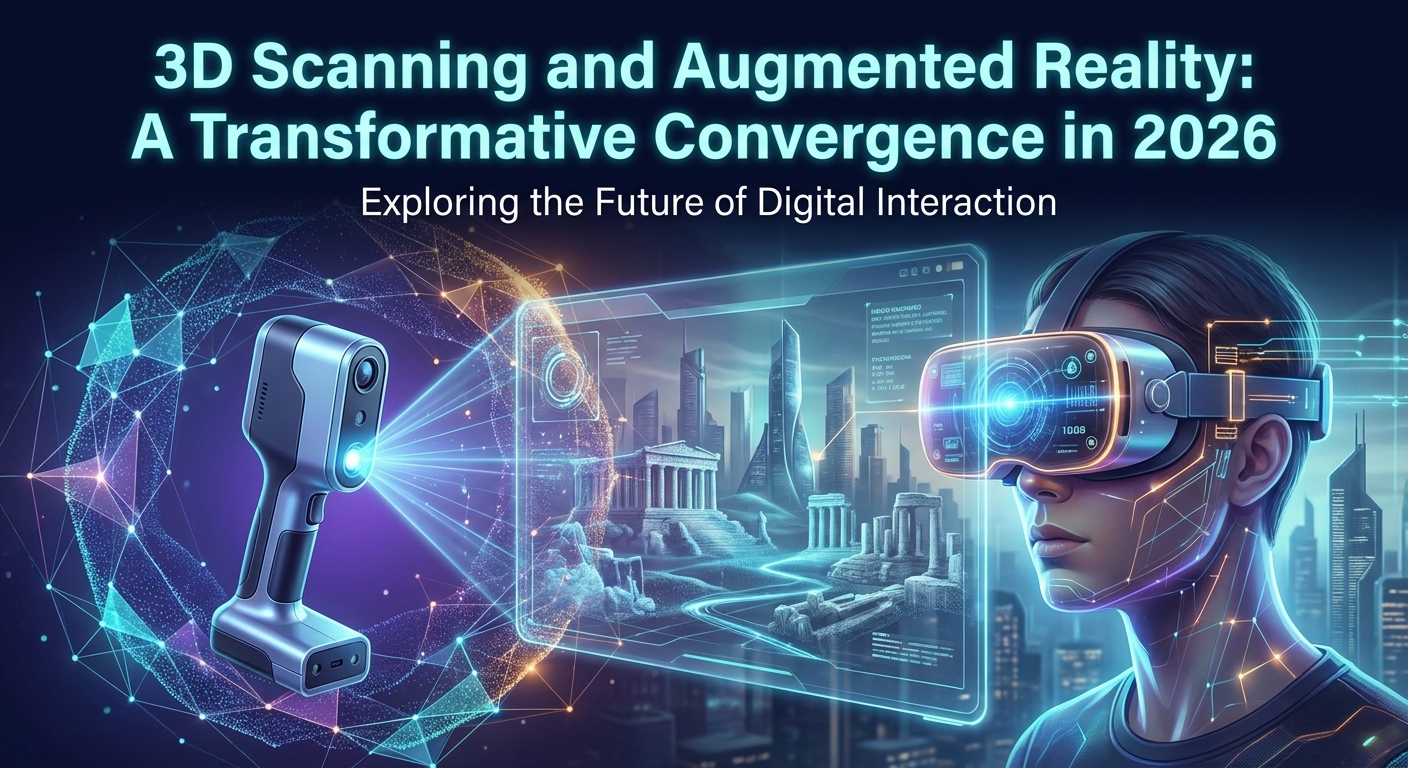
3D Scanning and Augmented Reality: A Transformative Convergence in 2026
3D scanning and augmented reality (AR) have converged to create a revolutionary landscape across various industries in 2026. This synergy allows for the seamless integration of real-world objects into digital environments, offering unprecedented opportunities for visualization, interaction, and problem-solving. From enhancing retail experiences to optimizing manufacturing processes, the combination of these technologies is reshaping how we interact with the world around us. In fact, market analysts predict the combined 3D scanning and AR market will exceed $30 billion by the end of 2026, a testament to its growing importance.
Key Takeaways
- 3D scanning captures real-world objects as digital 3D models, while AR overlays digital content onto the real world, creating interactive and immersive experiences.
- The convergence of 3D scanning and AR is transforming industries like retail, manufacturing, healthcare, and education by enabling new workflows and user experiences.
- Advancements in mobile devices, cloud computing, and AI are driving the accessibility and affordability of 3D scanning and AR solutions.
- Ethical considerations surrounding data privacy, security, and accessibility are becoming increasingly important as 3D scanning and AR become more pervasive.
- The future of 3D scanning and AR involves deeper integration with AI, real-time data processing, and more seamless user interfaces.
The Power of 3D Scanning: From Reality to Digital
3D scanning technology has matured significantly by 2026, becoming faster, more accurate, and more accessible. It provides a crucial link between the physical and digital realms, enabling the creation of accurate 3D models of real-world objects, environments, and even people. This capability is foundational for AR applications, allowing for realistic and interactive overlays.
Types of 3D Scanners in 2026
Several types of 3D scanners are prevalent in 2026, each with its own strengths and weaknesses:
- Structured Light Scanners: These scanners project a pattern of light onto an object and use cameras to capture the distortion of the pattern. They are known for their accuracy and speed, making them suitable for scanning small to medium-sized objects with intricate details. Companies like Creaform and Artec 3D continue to be major players in this market, offering high-resolution scanners capable of capturing fine details with accuracy levels reaching 0.02mm.
- Laser Scanners: Laser scanners use laser beams to measure the distance to an object's surface. They are highly versatile and can be used for both indoor and outdoor scanning. Terrestrial laser scanners, used for large-scale environments, can capture millions of data points per second with ranges exceeding 100 meters. LiDAR (Light Detection and Ranging) technology, a subset of laser scanning, is widely used in autonomous vehicles and mobile mapping.
- Photogrammetry: This technique uses photographs taken from different angles to reconstruct a 3D model. It is a cost-effective option, especially with the improved camera quality on smartphones and tablets. Software like RealityCapture and Agisoft Metashape have made photogrammetry more accessible to non-experts, allowing users to create detailed 3D models from a series of photographs. Advancements in AI-powered image processing have significantly improved the accuracy and speed of photogrammetry workflows.
- Time-of-Flight Scanners: These scanners measure the time it takes for a light signal to travel to an object and back. They are less accurate than structured light or laser scanners but offer longer ranges and are suitable for capturing large environments quickly. Time-of-flight sensors are increasingly integrated into mobile devices for AR applications.
Applications of 3D Scanning
The applications of 3D scanning are vast and span across numerous industries:
- Manufacturing: 3D scanning is used for quality control, reverse engineering, and rapid prototyping. By scanning existing parts, manufacturers can create digital models for replication or modification. For example, Boeing uses 3D scanning to inspect aircraft components for defects, reducing inspection time by up to 70% compared to traditional methods.
- Healthcare: In healthcare, 3D scanning is used for creating custom prosthetics, orthotics, and surgical guides. 3D scans of patients' bodies can be used to design personalized medical devices that fit perfectly and improve patient outcomes. Dental clinics commonly use intraoral scanners to create digital impressions of teeth, eliminating the need for messy physical molds.
- Cultural Heritage: 3D scanning is crucial for preserving and documenting historical artifacts and sites. Museums and archaeological organizations use 3D scanning to create digital replicas of fragile or inaccessible objects, allowing researchers and the public to study them remotely. The Smithsonian Institution, for example, has scanned numerous artifacts, making them available online for educational purposes.
- Retail: 3D scanning is used to create virtual fitting rooms and personalized product recommendations. Customers can scan their bodies using their smartphones and virtually try on clothes or accessories before making a purchase. This technology reduces returns and improves customer satisfaction. Companies like Amazon and Zara are experimenting with 3D body scanning to offer personalized shopping experiences.
Augmented Reality: Enhancing the Real World with Digital Overlays
Augmented reality (AR) overlays digital information onto the real world, creating interactive and immersive experiences. By 2026, AR technology has evolved beyond simple overlays, offering more sophisticated interactions, realistic rendering, and seamless integration with real-world environments.
AR Hardware and Platforms in 2026
- AR Glasses: Devices like the Apple Vision Pro (released in 2024 and now a mature product) and updated versions of Microsoft HoloLens offer immersive AR experiences with advanced features like spatial audio, hand tracking, and eye tracking. These glasses are becoming lighter, more comfortable, and more affordable, making them more appealing to consumers and businesses.
- Mobile AR: Smartphones and tablets continue to be the most accessible AR platforms. ARCore (Google) and ARKit (Apple) provide developers with tools to create AR apps that run on millions of devices. Mobile AR is used for a wide range of applications, including gaming, shopping, and education.
- Spatial Computing Platforms: Platforms like Magic Leap are focusing on spatial computing, which combines AR, VR, and mixed reality to create seamless and intuitive user experiences. These platforms use advanced sensors and AI to understand the user's environment and create realistic interactions.
Applications of Augmented Reality
AR is transforming various industries by providing new ways to interact with information and the physical world:
- Retail: AR is used to enhance the shopping experience by allowing customers to visualize products in their homes before buying them. Customers can use their smartphones to place virtual furniture in their living rooms or try on virtual clothes. Ikea's Place app and Sephora's Virtual Artist app are prime examples of how AR is used to drive sales and improve customer satisfaction.
- Manufacturing: AR is used to provide workers with real-time instructions and guidance during assembly and maintenance tasks. AR overlays can display step-by-step instructions, highlight specific components, and provide access to technical documentation. This technology reduces errors, improves efficiency, and lowers training costs. Companies like Siemens and Bosch are integrating AR into their manufacturing processes.
- Healthcare: AR is used for medical training, surgical planning, and patient education. Medical students can use AR to visualize anatomical structures and practice surgical procedures in a safe and controlled environment. Surgeons can use AR to overlay 3D models of patients' organs onto their bodies during surgery, improving accuracy and reducing the risk of complications.
- Education: AR is used to create interactive and engaging learning experiences. Students can use AR to explore historical sites, visualize complex scientific concepts, and interact with virtual objects. AR apps like Star Walk 2 allow students to explore the solar system in an immersive way.
The Convergence: 3D Scanning and AR in Action
The true power lies in the combination of 3D scanning and AR. By scanning real-world objects and overlaying them with digital content, these technologies create unprecedented opportunities for interaction and problem-solving.
Examples of 3D Scanning and AR Integration
- Virtual Try-On Applications: By scanning a customer's body using a smartphone, retailers can create a personalized 3D avatar that can be used to virtually try on clothes. This technology provides a more accurate and realistic try-on experience compared to traditional 2D methods, reducing returns and improving customer satisfaction. Companies like Nike and Adidas are exploring this technology to offer personalized shopping experiences.
- Architectural Visualization: Architects and designers can use 3D scanning to capture existing buildings and environments and then use AR to overlay proposed designs onto the real world. This allows clients to visualize the final product in context and make informed decisions. Apps like Augment are used by architects to showcase their designs to clients.
- Industrial Maintenance and Repair: Technicians can use 3D scanning to create digital twins of equipment and then use AR to overlay maintenance instructions and diagnostic information onto the real-world equipment. This technology reduces downtime, improves efficiency, and lowers maintenance costs. Companies like GE and Siemens are using 3D scanning and AR to optimize their maintenance operations.
- Gaming and Entertainment: 3D scanning and AR are used to create immersive gaming experiences. Players can scan their own faces and bodies to create personalized avatars that can be used in AR games. This technology blurs the line between the real and virtual worlds, creating more engaging and interactive experiences. Games like Pokémon Go and Harry Potter: Wizards Unite have demonstrated the potential of AR in the gaming industry.
Challenges and Opportunities
While the convergence of 3D scanning and AR offers immense potential, several challenges need to be addressed:
- Data Privacy and Security: 3D scanning captures detailed information about objects and environments, raising concerns about data privacy and security. It is crucial to implement robust security measures to protect sensitive data from unauthorized access and misuse.
- Computational Power and Bandwidth: Processing 3D scans and rendering AR overlays requires significant computational power and bandwidth. As AR applications become more sophisticated, it is essential to optimize algorithms and develop more efficient hardware to ensure smooth and responsive performance. The rise of edge computing is helping to address these issues by processing data closer to the user.
- User Experience and Interface Design: Designing intuitive and user-friendly AR interfaces is crucial for widespread adoption. AR interfaces should be seamless, unobtrusive, and easy to learn. Developers need to focus on creating AR experiences that are both engaging and practical.
The Future of 3D Scanning and Augmented Reality
The future of 3D scanning and AR is bright, with advancements in AI, cloud computing, and sensor technology driving innovation.
- AI-Powered 3D Scanning and AR: AI is used to improve the accuracy and speed of 3D scanning and AR. AI algorithms can automatically process 3D scans, remove noise, and create realistic textures. AI is also used to enhance AR overlays by providing intelligent object recognition and contextual information.
- Real-Time 3D Scanning and AR: The ability to scan and augment objects in real-time opens up new possibilities for interactive and dynamic AR experiences. Real-time 3D scanning and AR can be used for applications like remote collaboration, live performance, and interactive storytelling.
- Cloud-Based 3D Scanning and AR: Cloud computing provides the infrastructure and resources needed to process and store large amounts of 3D scan data and AR content. Cloud-based platforms enable users to access 3D scanning and AR tools from anywhere in the world, fostering collaboration and innovation. Companies like Microsoft and Amazon offer cloud-based AR services.
- Seamless Integration with IoT Devices: The integration of 3D scanning and AR with IoT devices creates new opportunities for smart homes, smart cities, and connected industries. AR overlays can display real-time data from IoT sensors, providing users with valuable insights and control over their environment.
The convergence of 3D scanning and augmented reality is set to continue to revolutionize industries and transform the way we interact with the world. As the technology matures and becomes more accessible, we can expect to see even more innovative applications emerge in the coming years.
Frequently Asked Questions
Q: What are the main differences between 3D scanning and augmented reality?
A: 3D scanning captures the geometry and texture of real-world objects to create digital 3D models. Augmented reality, on the other hand, overlays digital content onto the real world, enhancing our perception of reality. One creates a digital representation, the other enhances what we already see.
Q: How is 3D scanning used in the manufacturing industry in 2026?
A: 3D scanning plays a crucial role in manufacturing for quality control, reverse engineering, and rapid prototyping. It allows manufacturers to create accurate digital models of parts, inspect them for defects, and replicate or modify them as needed, improving efficiency and reducing costs.
Q: What are the key benefits of using augmented reality in retail?
A: Augmented reality enhances the retail experience by allowing customers to visualize products in their homes, try on virtual clothes, and access product information in an interactive way. This leads to increased customer engagement, reduced returns, and improved sales.
Q: What are the ethical considerations surrounding the use of 3D scanning and AR?
A: Ethical considerations include data privacy, security, and accessibility. 3D scanning captures detailed information about objects and environments, raising concerns about unauthorized access and misuse. It's important to ensure data is securely stored and used responsibly, while also addressing potential accessibility issues for people with disabilities.
Q: How are AI and machine learning enhancing 3D scanning and AR technologies?
A: AI and machine learning algorithms are used to improve the accuracy and speed of 3D scanning, remove noise from scans, and create realistic textures. In AR, AI enables intelligent object recognition, contextual information overlays, and personalized user experiences, making AR applications more intuitive and engaging.
Conclusion
The synergy between 3D scanning and augmented reality is creating transformative possibilities across industries. As technology continues to evolve, we can expect even greater integration, ultimately changing how we interact with the world around us. Explore the possibilities of integrating 3D scanning and AR into your business or personal projects today to stay ahead of the curve.