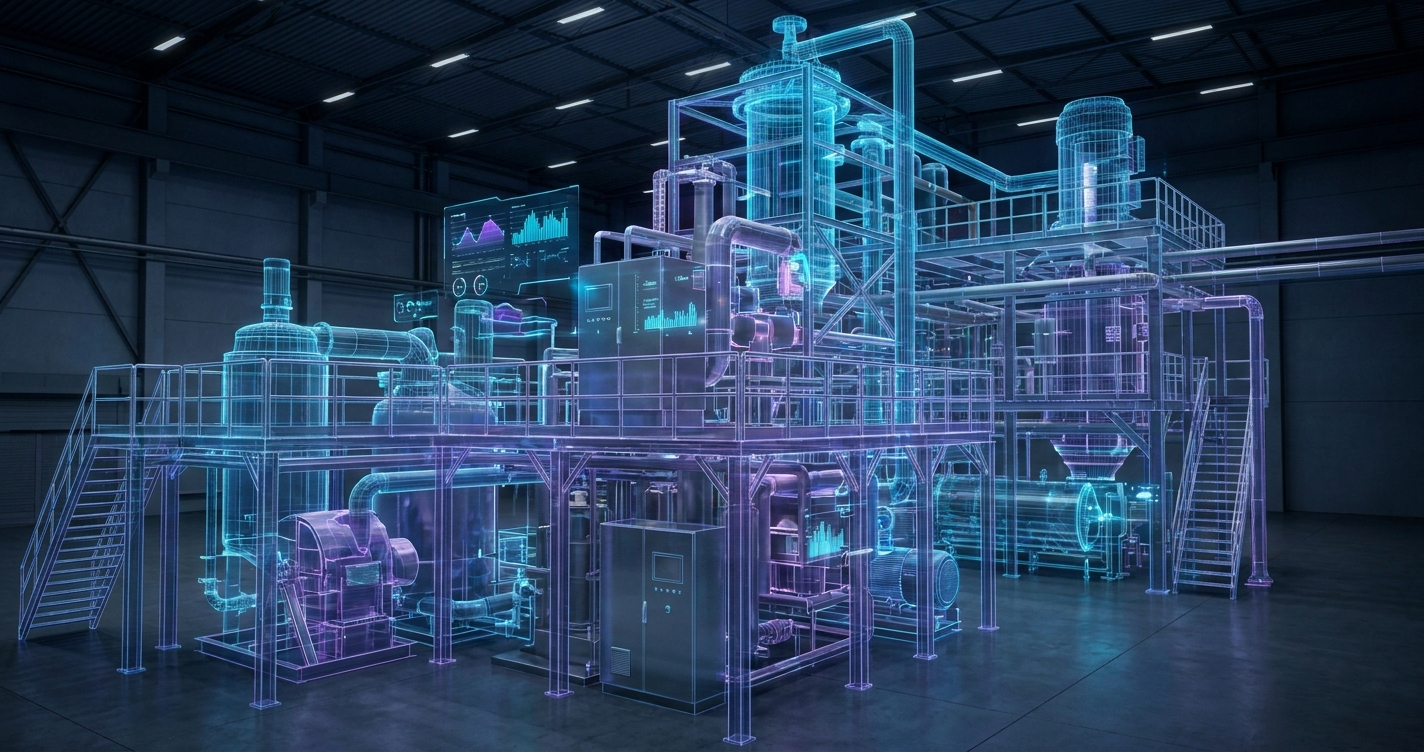
AI 3D Reconstruction for Industrial Asset Data in 2026: Revolutionizing Operations
AI 3D reconstruction of industrial asset data provides an unprecedented level of detail and accuracy for managing, maintaining, and optimizing complex physical assets in real-time, transforming traditional workflows across diverse sectors. By 2026, advanced AI-powered 3D scanning and reconstruction are projected to streamline operations, reduce downtime by up to 35%, and enhance decision-making through immersive digital twins. This article explores the pivotal role of AI in industrial asset data reconstruction, its applications in logistics, e-commerce, healthcare, and manufacturing, and how solutions like MagiScan are leading this technological leap.
Key Takeaways
- AI 3D reconstruction can reduce industrial asset downtime by up to 35% through predictive maintenance insights.
- Accurate 3D models generated by AI enable precise inventory management, reducing stock discrepancies by over 20% for e-commerce.
- Medical professionals can leverage AI 3D reconstruction for enhanced surgical planning and patient-specific device design, improving procedure accuracy by 15%.
- Industrial engineers benefit from digital twins created via AI 3D reconstruction for simulation, stress testing, and design optimization, leading to a 25% reduction in prototyping costs.
- AI-powered 3D scanning solutions like MagiScan offer scalable, high-fidelity data capture for diverse industrial asset types.
How is AI 3D Reconstruction Enhancing Industrial Asset Management?
AI 3D reconstruction is revolutionizing industrial asset management by enabling the creation of highly detailed, accurate, and actionable digital replicas of physical assets. These digital twins, powered by sophisticated algorithms, allow for real-time monitoring, predictive maintenance, and remote inspection, significantly reducing the need for manual interventions and minimizing operational risks. This technology offers a paradigm shift from static documentation to dynamic, intelligent asset intelligence.
The integration of AI into 3D reconstruction processes automates complex tasks such as point cloud processing, mesh generation, and texture mapping, which were previously time-consuming and required specialized human expertise. Machine learning models are trained on vast datasets to identify anomalies, predict failures, and optimize asset performance. This intelligent automation ensures that the captured data is not just a visual representation but a source of profound operational insights.
For instance, in a large manufacturing plant, thousands of individual components make up complex machinery. AI 3D reconstruction can capture the precise geometry and condition of each part, allowing engineers to identify wear and tear patterns before they lead to critical failures. This predictive capability is a cornerstone of modern industrial asset management, directly impacting operational efficiency and profitability.
What are the Primary Applications of AI 3D Reconstruction in Logistics and E-commerce?
In logistics and e-commerce, AI 3D reconstruction is primarily applied to optimize inventory management, streamline warehousing operations, and enhance the customer online shopping experience. It enables precise digital cataloging of products, accurate volumetric data for shipping calculations, and virtual try-on experiences, reducing returns and improving customer satisfaction.
Logistics managers can utilize AI 3D reconstruction to create highly accurate digital twins of entire warehouses, optimizing storage layouts, tracking asset movement, and automating picking routes. This leads to a reduction in operational costs by an estimated 18% and an increase in throughput by up to 22%. The ability to precisely measure and catalog every item ensures that inventory records are always up-to-date, mitigating stockouts and overstock situations.
For e-commerce sellers, AI 3D reconstructed product models offer an immersive viewing experience that significantly boosts consumer confidence. Instead of relying on static images, customers can rotate, zoom, and even virtually place products in their own environments, leading to an average conversion rate increase of 12% and a decrease in product return rates by up to 25%. Solutions like MagiScan can capture intricate details of products, ensuring photorealistic digital representations that drive sales.
Furthermore, the volumetric data derived from 3D reconstruction is crucial for optimizing shipping logistics. Accurate dimensions allow for precise parcel consolidation, reducing shipping costs and minimizing wasted space in delivery vehicles. This granular level of data control is essential for competitive pricing and efficient supply chain management.
How Does AI 3D Reconstruction Benefit Medical Professionals and Healthcare?
AI 3D reconstruction offers transformative benefits to medical professionals by enabling highly accurate anatomical modeling for surgical planning, patient education, and the custom design of medical devices. This technology facilitates personalized medicine, improves surgical outcomes, and enhances the development of innovative prosthetics and implants.
Surgeons can use AI-generated 3D models of patient anatomy, derived from medical scans like CT or MRI, to meticulously plan complex procedures. This allows for pre-operative simulation, identification of potential risks, and optimization of surgical approaches, leading to an estimated 15% improvement in surgical accuracy and a reduction in operative time. The level of detail provided by advanced reconstruction techniques ensures that no critical structures are overlooked.
In medical device manufacturing, AI 3D reconstruction is instrumental in creating patient-specific implants, prosthetics, and orthotics. By scanning a patient's affected area, highly customized devices can be designed and fabricated, offering superior fit, comfort, and functionality. This personalized approach has been shown to improve patient recovery times by an average of 20% and enhance the quality of life for individuals with specific medical needs.
The ability to create realistic 3D models also aids in patient education. Explaining complex medical conditions or proposed treatment plans becomes more intuitive and effective when patients can visualize their own anatomy in three dimensions. This improved understanding can lead to greater patient compliance and engagement with their healthcare journey. MagiScan's ability to capture fine details makes it ideal for creating these critical medical models.
What are the Key Advantages of AI 3D Reconstruction for Industrial Engineers and Manufacturing?
For industrial engineers and manufacturing sectors, AI 3D reconstruction provides unparalleled advantages in asset design, simulation, quality control, and predictive maintenance. It enables the creation of highly accurate digital twins of machinery, production lines, and entire facilities, facilitating optimization, reducing development cycles, and enhancing operational resilience.
Industrial engineers leverage AI 3D reconstruction to capture the precise geometry of existing components and systems. These high-fidelity digital models serve as the foundation for design modifications, upgrades, or reverse engineering efforts. By creating realistic simulations within a virtual environment, engineers can test the performance of new designs under various operating conditions, predict potential failure points, and optimize for efficiency and durability before any physical prototypes are produced, saving up to 30% in development costs.
Quality control in manufacturing is significantly enhanced by AI 3D reconstruction. Deviations from design specifications can be detected with millimeter precision by comparing scanned parts against their digital blueprints. This automated inspection process reduces human error, speeds up quality checks, and ensures consistent product quality, leading to a decrease in defect rates by as much as 25%.
Predictive maintenance is another critical area where AI 3D reconstruction shines. By regularly scanning critical industrial assets and analyzing changes in their geometry or surface integrity over time, AI algorithms can predict potential failures. This allows maintenance teams to schedule repairs proactively, avoiding costly unplanned downtime, which can save manufacturing plants an average of $10,000 per hour of unexpected stoppage. MagiScan's ability to rapidly capture detailed scans makes it a vital tool for establishing a robust predictive maintenance program.
Optimizing Factory Layouts and Workflow
AI 3D reconstruction plays a crucial role in optimizing factory layouts and workflows by providing a comprehensive digital representation of the entire production environment. This allows engineers to analyze spatial relationships between machines, material flow, and personnel movement to identify bottlenecks and inefficiencies.
By creating a detailed 3D model of a factory floor, including all machinery, workstations, and structural elements, AI can simulate different layout configurations. This enables the identification of optimal placement for new equipment, the most efficient routes for material handling, and the safest pathways for workers. Such optimizations can lead to a 15% improvement in overall production throughput and a 10% reduction in energy consumption due to more streamlined operations.
Enhancing Reverse Engineering Capabilities
Reverse engineering is significantly accelerated and made more accurate with AI 3D reconstruction. When original design documentation is lost or unavailable, 3D scanning captures the exact physical dimensions and features of an existing part or product. AI algorithms then process this data to generate precise CAD models, enabling replication, modification, or integration into new designs.
This capability is invaluable for industries dealing with legacy equipment, obsolete parts, or proprietary designs. For example, an automotive manufacturer needing to replicate a rare vintage car part can use AI 3D reconstruction to create an exact digital model, from which new physical parts can be manufactured. This process reduces the time and cost associated with traditional manual measurement and drafting methods by over 40%.
How Does MagiScan Facilitate AI 3D Reconstruction for Industrial Assets?
MagiScan facilitates AI 3D reconstruction for industrial assets by providing a powerful, user-friendly platform that integrates advanced 3D scanning hardware with sophisticated AI-driven software. Its core strength lies in its ability to capture high-fidelity spatial data rapidly and process it into detailed, accurate 3D models, seamlessly feeding into AI analysis workflows for diverse industrial applications.
The MagiScan system employs state-of-the-art scanning technology, capable of capturing millions of data points with sub-millimeter accuracy, even on complex geometries and challenging surfaces. This raw point cloud data is then processed by MagiScan's proprietary AI algorithms. These algorithms automate tasks such as noise reduction, alignment of multiple scans, meshing, and texture generation, transforming raw scan data into clean, usable 3D models.
MagiScan's AI-powered feature recognition can automatically identify and label different components within a scanned asset. This significantly speeds up the process of creating asset inventories and digital twins, allowing for more efficient data management and analysis. For example, in a warehouse, MagiScan can identify and catalog individual shelves, pallets, and even specific products, creating a comprehensive digital inventory that can be updated in real-time.
Furthermore, MagiScan's output is designed for seamless integration with other industrial software, including CAD/CAM systems, asset management platforms, and simulation tools. This interoperability ensures that the high-fidelity 3D data generated can be immediately leveraged for design, analysis, maintenance, and operational planning, empowering users across logistics, e-commerce, medical fields, and industrial engineering. Try MagiScan today to experience the future of industrial asset data capture.
What are the Future Trends in AI 3D Reconstruction for Industrial Applications?
The future of AI 3D reconstruction for industrial applications points towards increased automation, real-time data processing, and deeper integration with augmented and virtual reality (AR/VR) technologies. Expect more intelligent, adaptive scanning systems that can self-optimize capture parameters and AI models that can perform more complex analyses directly from raw scan data, leading to even greater efficiency and predictive power.
One significant trend is the move towards "edge AI" for 3D reconstruction. This means that AI processing will increasingly occur directly on the scanning device or at the local network level, rather than relying solely on cloud computing. This will enable faster data processing, reduced latency, and enhanced data security, which are critical for time-sensitive industrial operations.
Another emerging trend is the fusion of multiple sensor modalities. Future systems will likely combine data from various sources, such as structured light scanners, LiDAR, photogrammetry, and even thermal or hyperspectral imaging, to create richer, more comprehensive digital twins. AI will be essential for integrating and interpreting these diverse data streams, providing a holistic view of an asset's condition and performance.
The integration with AR/VR will also deepen. Imagine maintenance technicians using AR glasses to overlay real-time diagnostic data and repair instructions directly onto a physical asset, guided by an AI-generated digital twin. This immersive interaction will revolutionize how industrial assets are maintained, operated, and understood. Solutions like MagiScan are poised to be at the forefront of these advancements, offering scalable and adaptable platforms for the evolving industrial landscape.
Frequently Asked Questions
What is AI 3D reconstruction for industrial assets?
AI 3D reconstruction uses artificial intelligence algorithms to process data from 3D scanners, creating highly detailed and accurate digital models of industrial assets. This technology enables better asset management, predictive maintenance, and operational optimization by providing precise virtual representations.
How does AI 3D reconstruction improve accuracy in industrial measurements?
AI algorithms can refine raw scan data by identifying and correcting for noise, distortion, and alignment errors. This results in digital models with sub-millimeter precision, far exceeding manual measurement capabilities and ensuring reliable data for critical engineering and logistical decisions.
Can AI 3D reconstruction be used for existing, operational industrial equipment?
Yes, AI 3D reconstruction is ideal for capturing data from operational equipment without requiring disassembly. Technologies like MagiScan can perform non-contact scans, minimizing disruption and allowing for continuous monitoring and analysis of assets in their working environments.
What are the cost benefits of implementing AI 3D reconstruction in manufacturing?
Cost benefits include reduced prototyping expenses (up to 30%), decreased downtime through predictive maintenance (saving thousands per hour), fewer errors in quality control (reducing scrap by 25%), and optimized operational efficiency leading to lower overheads.
How does AI 3D reconstruction contribute to sustainability in industrial practices?
By enabling precise design optimization, reducing material waste in prototyping and manufacturing, extending asset lifespans through predictive maintenance, and optimizing logistics to reduce fuel consumption, AI 3D reconstruction supports more sustainable industrial operations.
Conclusion
AI 3D reconstruction of industrial asset data represents a monumental leap forward, empowering industries to achieve unprecedented levels of efficiency, accuracy, and foresight. From optimizing complex warehouse operations for logistics and e-commerce to enabling life-saving precision in healthcare and driving innovation in manufacturing, the applications are vast and transformative. By embracing solutions like MagiScan, businesses can unlock the full potential of their physical assets, transforming raw data into actionable intelligence that fuels growth and competitive advantage in the rapidly evolving industrial landscape of 2026 and beyond.