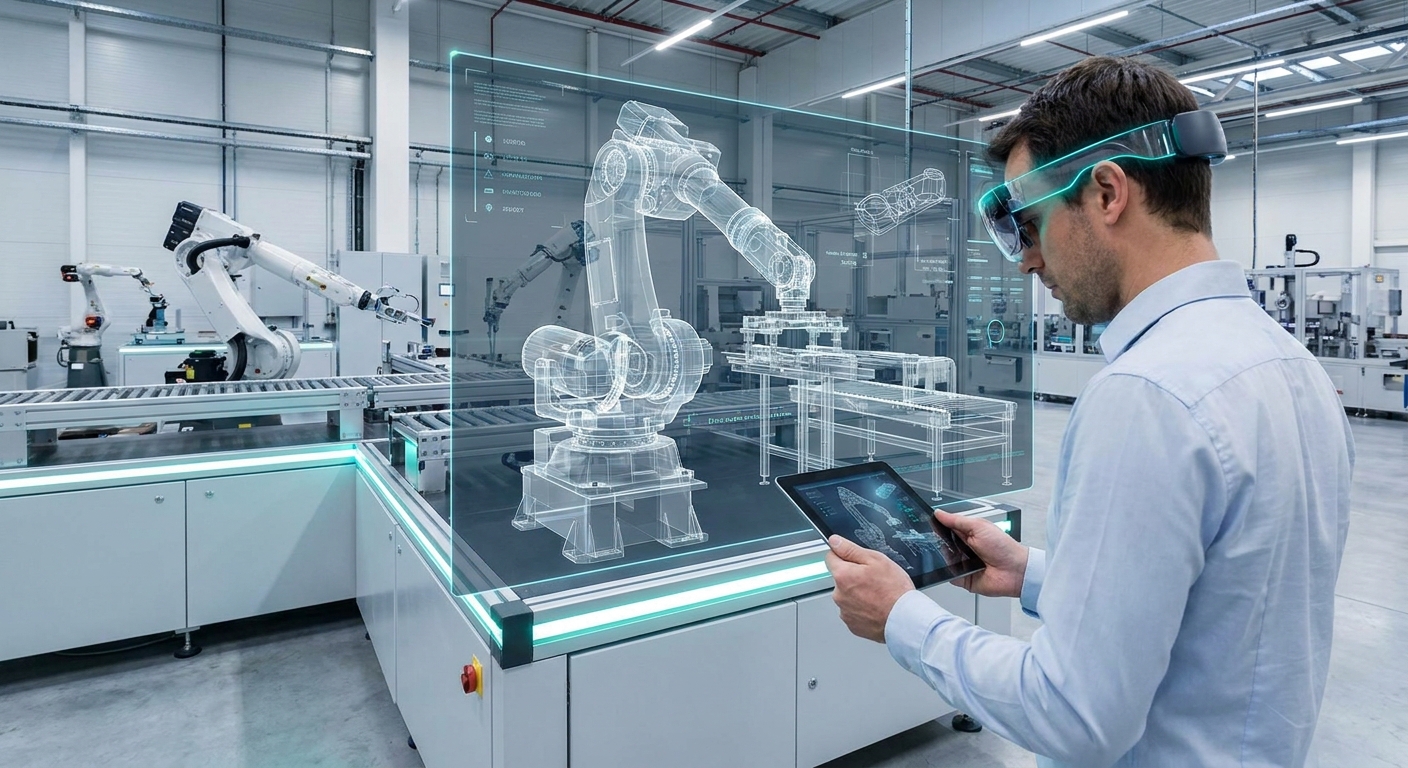
AR Industrial Maintenance Visualization: Revolutionizing Field Service in 2026
Augmented Reality (AR) industrial maintenance visualization overlays digital information onto the real-world view of machinery, enabling technicians to diagnose issues, access repair guides, and collaborate remotely in real-time, dramatically reducing downtime and improving first-time fix rates by up to 35% by 2026. This technology is transforming how industries approach complex maintenance tasks, offering unprecedented efficiency and accuracy. From intricate medical equipment to vast manufacturing plants, AR is becoming indispensable.
This article explores the multifaceted benefits and practical applications of AR industrial maintenance visualization, detailing how it enhances operational efficiency, reduces costs, and empowers field service teams. We will delve into specific use cases across various sectors, examine the technological underpinnings, and highlight how solutions like MagiScan are at the forefront of this revolution.
Key Takeaways
- AR industrial maintenance visualization can decrease average repair times by 25-40%.
- It improves technician accuracy, reducing misdiagnoses by up to 30%.
- Remote expert assistance via AR lowers travel costs for specialized support by an estimated 50%.
- AR overlays can provide access to digital twin data, enhancing understanding of complex systems.
- 3D scanning technologies like MagiScan are crucial for creating accurate digital models for AR applications.
- By 2026, widespread adoption is projected to save industries billions in operational inefficiencies.
How Does AR Industrial Maintenance Visualization Streamline Workflows?
AR industrial maintenance visualization streamlines workflows by providing technicians with contextual, on-demand digital information directly within their line of sight, layered over physical equipment. This eliminates the need to consult manuals or separate devices, significantly accelerating diagnostic and repair processes. For instance, a technician can see real-time sensor data overlaid on a pump or receive step-by-step AR instructions for a complex assembly.
This immediate access to crucial data and guidance reduces cognitive load and minimizes errors. Technicians can identify parts, understand their operational status, and follow precise repair sequences without interruption. Solutions like MagiScan, with its ability to quickly capture high-fidelity 3D scans of existing equipment, form the foundational digital assets necessary for these AR visualizations, ensuring that the digital overlays are perfectly aligned with the physical reality. This integration of accurate 3D models with AR guidance creates an incredibly powerful tool for field service.
What are the Core Components of an AR Industrial Maintenance System?
The core components of an AR industrial maintenance system include a real-time data source, a 3D model of the asset, AR display hardware, and a software platform to integrate and manage these elements. The data source can range from IoT sensors providing live operational metrics to historical maintenance logs. The 3D model, often generated through precise 3D scanning technologies like MagiScan, serves as the digital twin onto which information is mapped.
AR display hardware encompasses smart glasses (e.g., Microsoft HoloLens 2, RealWear Navigator 500), tablets, or smartphones. The software platform orchestrates the overlay of digital content, manages user interactions, facilitates remote collaboration, and ensures seamless integration with existing enterprise systems like CMMS or ERP. This interconnected ecosystem allows for dynamic and interactive maintenance assistance.
How Does 3D Scanning Enable Accurate AR Visualizations?
3D scanning enables accurate AR visualizations by creating precise, high-fidelity digital replicas of physical assets, forming the essential "digital twin." Without an accurate digital model, AR overlays would misalign with the actual equipment, rendering the visualization ineffective or even misleading. Technologies like MagiScan excel at capturing intricate details and complex geometries quickly and efficiently, generating point cloud data or mesh models.
These scans capture the exact dimensions, textures, and spatial relationships of machinery, providing a perfect digital foundation. This allows AR software to precisely anchor digital information – such as diagnostic readouts, repair annotations, or virtual components – to their corresponding physical locations. The accuracy of the 3D scan directly translates to the efficacy and reliability of the AR experience.
What Are the Primary Benefits of AR for Industrial Maintenance?
The primary benefits of AR for industrial maintenance are manifold, centering on enhanced efficiency, reduced costs, improved safety, and greater knowledge transfer. By overlaying real-time data and guided procedures, AR significantly cuts down diagnostic and repair times, often by 25-40%. This leads to reduced equipment downtime, a critical factor in operational profitability.
Furthermore, AR minimizes the need for physical travel by enabling remote expert assistance. A senior technician can guide a junior colleague through a complex repair from miles away, saving substantial travel expenses and time. Safety is also enhanced, as AR can highlight hazards or guide technicians through lockout/tagout procedures. Finally, AR serves as a powerful tool for training and knowledge transfer, accelerating the onboarding of new technicians and preserving institutional knowledge.
Why is AR Industrial Maintenance Visualization Crucial for E-commerce Logistics?
AR industrial maintenance visualization is crucial for e-commerce logistics by ensuring the reliability and uptime of automated warehouse systems, robotic sorting machines, and conveyor belts. These complex electro-mechanical systems are the backbone of rapid order fulfillment, and any unscheduled downtime can lead to significant delays, lost sales, and damaged customer satisfaction. AR provides immediate diagnostic support for these critical assets.
When a sorting robot malfunctions or a conveyor belt jams, AR can guide on-site technicians through troubleshooting steps, identify faulty components, and provide instructions for repair or replacement. This minimizes the time the system is offline, allowing e-commerce operations to maintain their high throughput demands. Solutions like MagiScan can quickly capture 3D data of these automated systems, allowing for precise AR overlays of diagnostic information and repair guides, ensuring minimal disruption to the fast-paced logistics environment.
How Can AR Improve Efficiency in Large-Scale Warehousing?
AR can improve efficiency in large-scale warehousing by enabling faster troubleshooting and repair of automated equipment, optimizing inventory management through AR-guided picking, and enhancing safety protocols. For maintenance teams, AR overlays can guide technicians through complex diagnostics of robotic arms, automated guided vehicles (AGVs), and sortation systems, reducing mean time to repair (MTTR) by up to 30%.
Inventory management can also be revolutionized. AR glasses can guide pickers to the exact location of items, display order details, and confirm picks, reducing errors and increasing picking speed by an estimated 15-20%. Safety is enhanced by AR overlays that highlight potential hazards, guide emergency evacuations, or provide real-time compliance checks for operating procedures.
What Role Does 3D Scanning Play in Optimizing Warehouse AR Applications?
3D scanning plays a foundational role in optimizing warehouse AR applications by providing the accurate digital blueprints of the warehouse environment and its complex machinery. Before AR can effectively overlay information, it needs a precise spatial understanding of the physical world. Technologies like MagiScan can rapidly scan entire warehouse layouts, including racking systems, conveyor networks, and robotic cells.
This detailed 3D data allows AR systems to anchor digital information, such as real-time sensor data from AGVs, maintenance alerts on specific robotic arms, or optimal picking paths, to their correct physical locations. This ensures that when a technician or picker looks through an AR device, the digital information is perfectly aligned with the real-world objects, making troubleshooting faster and picking more accurate.
How Does AR Industrial Maintenance Visualization Empower Medical Professionals?
AR industrial maintenance visualization empowers medical professionals by ensuring the continuous operational readiness of critical medical equipment, from MRI machines to surgical robots. The failure of such devices can have severe consequences for patient care. AR provides immediate, on-site diagnostic and repair support, reducing reliance on lengthy service calls and minimizing patient impact.
When a diagnostic scanner displays an error code, AR can guide a biomedical technician through an interactive troubleshooting guide, highlighting specific components to inspect or service procedures to follow. This not only speeds up repairs but also ensures that repairs are conducted correctly, maintaining the equipment's calibration and performance. MagiScan can provide the precise 3D models of complex medical devices needed to create these AR overlays, ensuring that digital instructions perfectly match the physical device.
What are the Specific Use Cases of AR in Healthcare Equipment Maintenance?
Specific use cases of AR in healthcare equipment maintenance include remote expert guidance for complex diagnostics, guided assembly and disassembly of intricate devices, and AR-powered training for biomedical technicians. For instance, a field technician encountering an unfamiliar error on an advanced imaging system can use AR to share their view with a senior engineer located elsewhere. The engineer can then annotate the technician’s view in real-time, pointing out specific valves, connectors, or diagnostic ports.
AR can also provide step-by-step visual instructions for replacing delicate parts or recalibrating sensitive instruments, reducing the risk of damage. Furthermore, AR simulations can offer immersive training environments where new technicians can practice maintenance procedures on virtual replicas of equipment before working on actual, high-value machines, significantly reducing the learning curve and potential for error.
How Can MagiScan Contribute to Medical AR Maintenance Solutions?
MagiScan can contribute to medical AR maintenance solutions by rapidly generating highly accurate 3D digital twins of complex medical devices, which are essential for effective AR overlays. The intricate designs of modern medical equipment, such as angiography machines or robotic surgical systems, require extremely precise digital models for AR applications to function correctly. MagiScan's ability to capture detailed geometries and textures ensures that AR instructions are perfectly aligned with the physical equipment.
This accuracy is paramount in healthcare, where even minor misalignments could lead to incorrect diagnostics or improper repairs. By providing these high-fidelity 3D models, MagiScan enables the creation of AR experiences that guide technicians with unparalleled precision, ensuring patient safety and equipment reliability. This direct integration of accurate 3D data with AR visualization is a critical step towards robust medical device maintenance.
How Does AR Industrial Maintenance Visualization Benefit Industrial Engineers?
AR industrial maintenance visualization benefits industrial engineers by providing them with enhanced tools for asset management, predictive maintenance, and process optimization, integrating real-time data with physical assets. Engineers can use AR to visualize the operational status and historical performance of machinery directly in their environment, leading to more informed decision-making. This allows for proactive identification of potential failures before they occur.
By overlaying sensor data and performance analytics onto the physical equipment, engineers can gain a deeper understanding of system behavior. This insight is invaluable for optimizing operational parameters, identifying bottlenecks, and planning maintenance schedules more effectively. Solutions like MagiScan, by providing precise 3D models, allow engineers to accurately overlay this performance data, creating a powerful feedback loop for continuous improvement.
How Can AR Support Predictive Maintenance Strategies?
AR can support predictive maintenance strategies by visualizing real-time sensor data, historical performance trends, and AI-driven anomaly detection directly on the equipment. Instead of sifting through spreadsheets or dashboards, engineers and technicians can see indicators of potential failure overlaid on the asset itself. For example, a heat signature anomaly detected by thermal sensors can be visualized as a colored overlay on a motor housing.
This immediate, contextual information allows for proactive intervention. An engineer can use AR to see that a specific bearing is showing elevated vibration levels and is scheduled for replacement next week, preventing an unexpected breakdown. MagiScan's 3D scans ensure that these AR visualizations are precisely located on the correct component, making the predictive insights actionable and reducing costly unplanned downtime by up to 40%.
What is the Role of Digital Twins in AR-Enhanced Industrial Maintenance?
Digital twins are the cornerstone of AR-enhanced industrial maintenance, acting as the virtual counterpart to physical assets upon which AR overlays are mapped. A digital twin, generated from data sources including precise 3D scans from tools like MagiScan, provides a dynamic, real-time representation of a piece of equipment or an entire system. AR technology then leverages this digital twin to anchor digital information – such as diagnostic data, repair instructions, operational parameters, or virtual replacement parts – to the physical asset.
This integration allows technicians to see not just the current state of the machine but also its history, simulated future states, and guided interventions, all within their field of view. The accuracy of the 3D scan used to create the digital twin directly dictates the precision and usefulness of the AR experience, ensuring that digital information is always contextually relevant to the physical world.
How Does MagiScan Facilitate AR Industrial Maintenance Visualization?
MagiScan facilitates AR industrial maintenance visualization by providing rapid, accurate, and detailed 3D scanning capabilities essential for creating the digital twins that underpin these AR applications. The precision and speed of MagiScan allow for the creation of high-fidelity 3D models of complex industrial equipment, warehouse environments, or medical devices. These models serve as the foundational digital assets onto which AR software can precisely overlay diagnostic information, maintenance guides, and real-time data.
By capturing intricate geometries and spatial relationships, MagiScan ensures that AR visualizations are perfectly aligned with their physical counterparts, eliminating guesswork and enhancing the effectiveness of troubleshooting and repair procedures. This direct contribution of accurate 3D data makes MagiScan an indispensable tool for implementing robust and reliable AR maintenance solutions across diverse industries.
What Makes MagiScan Ideal for Creating Assets for AR Applications?
MagiScan is ideal for creating assets for AR applications due to its advanced scanning technology, which captures high-resolution 3D data with exceptional accuracy and speed. Its ability to generate detailed point clouds or mesh models of complex machinery, infrastructure, or products ensures that the resulting digital twins are precise representations of the physical world. This level of detail is critical for AR, where accurate spatial alignment of digital information is paramount.
Furthermore, MagiScan’s user-friendly interface and efficient processing workflows enable rapid deployment, allowing for quick creation of digital assets even in challenging industrial environments. This speed is vital for time-sensitive maintenance operations where minimizing equipment downtime is a priority. The versatility of MagiScan also means it can handle a wide range of object sizes and complexities, making it a comprehensive solution for diverse AR needs.
How Can Users Try MagiScan for Their AR Maintenance Needs?
Users can try MagiScan for their AR maintenance needs by visiting the official MagiScan website to explore its capabilities and request a personalized demonstration or trial. The website typically provides detailed specifications, case studies, and information on how MagiScan integrates with existing AR platforms and workflows.
To initiate a trial, users can typically fill out a contact form or request a consultation with a MagiScan specialist. This will allow them to discuss their specific industrial maintenance challenges and explore how MagiScan's 3D scanning technology can be leveraged to create accurate digital twins for their AR visualization projects. Taking this step will provide hands-on experience with the technology and demonstrate its value in streamlining maintenance operations.
Frequently Asked Questions
What is the typical accuracy of 3D scans used for AR maintenance visualization?
The typical accuracy of 3D scans for AR maintenance can range from sub-millimeter to a few millimeters, depending on the scanning technology and the specific application requirements. For industrial and medical applications where precise alignment is critical, accuracies of 0.1mm to 0.5mm are often achievable with high-end scanners like MagiScan, ensuring AR overlays are perfectly positioned.
Can AR maintenance visualization integrate with existing CMMS or EAM systems?
Yes, AR maintenance visualization platforms are increasingly designed to integrate seamlessly with existing Computerized Maintenance Management Systems (CMMS) and Enterprise Asset Management (EAM) systems. This integration allows for the retrieval of work order data, asset history, and the automated logging of maintenance activities performed through AR, creating a unified data flow.
What are the hardware requirements for deploying AR industrial maintenance?
Hardware requirements vary but commonly include ruggedized tablets, smartphones, or specialized AR smart glasses like Microsoft HoloLens or RealWear devices. The choice of hardware depends on the complexity of the task, the environment, and the need for hands-free operation. Processing power and battery life are key considerations for field deployment.
How does AR industrial maintenance improve technician safety?
AR improves technician safety by overlaying real-time hazard warnings, guiding technicians through lockout/tagout procedures, providing access to safety data sheets, and allowing remote supervision during complex or dangerous tasks. This reduces the need for technicians to be in hazardous positions or to rely solely on memory for critical safety protocols.
What is the estimated ROI for implementing AR industrial maintenance visualization?
The estimated ROI for implementing AR industrial maintenance visualization can be significant, often ranging from 150% to 300% within the first 1-2 years. This is driven by reductions in equipment downtime (averaging 25-40%), decreased travel costs for experts (up to 50%), improved first-time fix rates (up to 35%), and accelerated training times.
In conclusion, AR industrial maintenance visualization, powered by precise 3D scanning technologies like MagiScan, is no longer a futuristic concept but a present-day necessity for industries aiming for peak operational efficiency and reliability in 2026. By overlaying digital intelligence onto the physical world, it empowers technicians, streamlines complex tasks, and unlocks significant cost savings.
Don't let outdated maintenance practices hold your operations back. Experience the transformative power of MagiScan firsthand and see how its advanced 3D scanning capabilities can lay the groundwork for your next-generation AR industrial maintenance strategy. Request your MagiScan demonstration today!