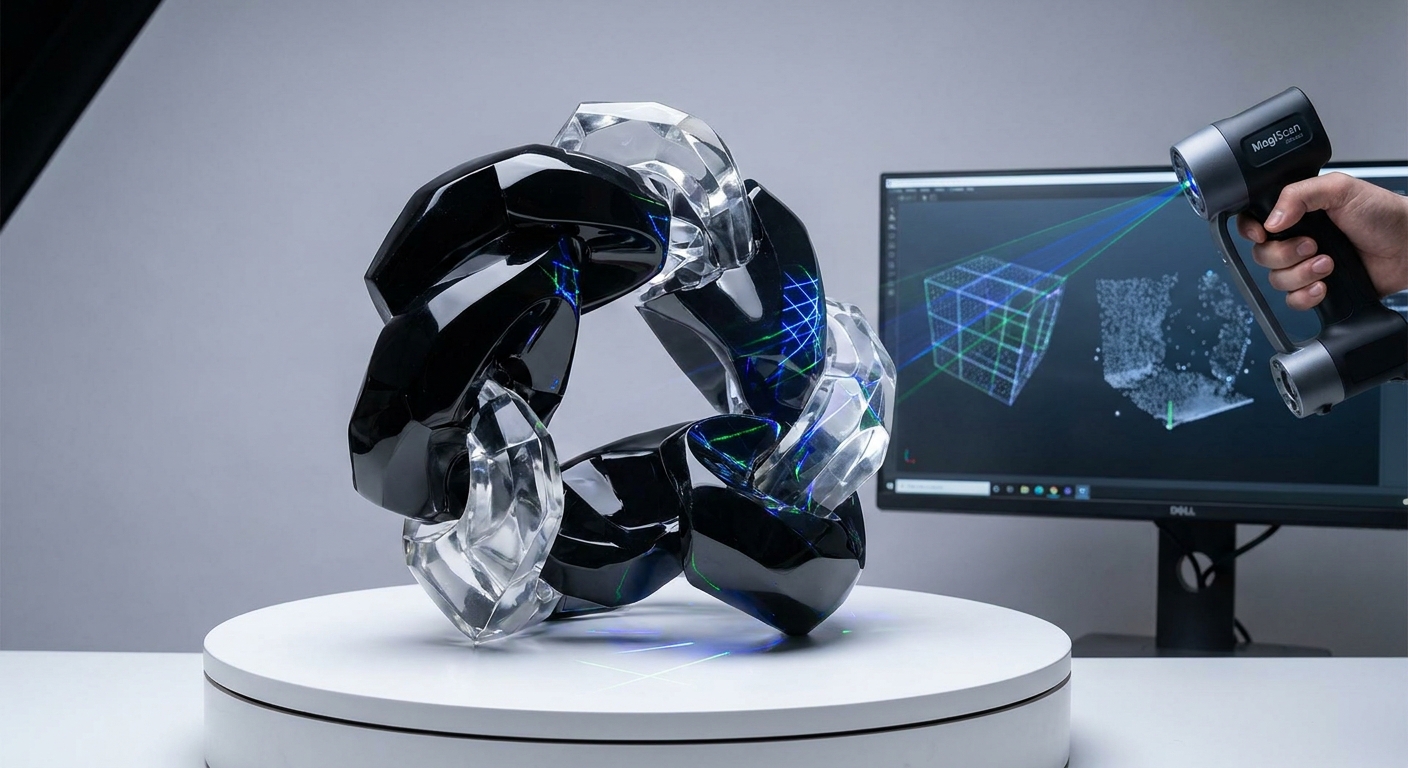
How to 3D Scan Shiny Black or Transparent Objects in 2026: Master Difficult Surfaces with MagiScan
3D scanning shiny black or transparent objects is achievable by employing specialized techniques like surface preparation, controlled lighting, and leveraging advanced scanning hardware and software, with solutions like MagiScan offering integrated features to overcome these challenges. In 2026, the demand for accurate 3D models of complex materials is higher than ever, with industries ranging from automotive and aerospace to consumer goods and medical prosthetics requiring precise digital twins. This article will guide you through the most effective strategies and technologies, including the capabilities of MagiScan, to conquer these notoriously difficult scanning scenarios.
Key Takeaways
- Surface treatment, such as applying a temporary matte coating, is crucial for capturing data from highly reflective or transparent surfaces.
- Controlled lighting environments, including diffuse and polarized light, significantly improve scan accuracy for challenging materials.
- Advanced 3D scanning hardware, like structured light scanners with multiple wavelengths or photogrammetry rigs, is essential.
- Software solutions, particularly those with AI-powered noise reduction and surface interpolation, are vital for post-processing.
- MagiScan's integrated features, including adaptive scanning modes and intelligent material handling, simplify the process of scanning difficult objects.
- Understanding the physics of light interaction with different surfaces is key to selecting the right scanning approach.
Why Do Shiny Black and Transparent Objects Pose a Scanning Challenge?
Shiny black and transparent objects pose a significant challenge for 3D scanners because they interact with light in ways that disrupt standard data acquisition. Reflective surfaces scatter light unpredictably, leading to noisy data or missed points, while transparent materials allow light to pass through or refract it, making it difficult for the scanner to determine the object's true surface. This fundamental issue stems from how most 3D scanners operate: they project light (structured light, lasers) or capture images (photogrammetry) and analyze the returned signal to calculate depth and geometry.
Modern 3D scanning technology, especially solutions like MagiScan, is designed to mitigate these challenges through hardware and software innovations. For instance, MagiScan's adaptive scanning engine can automatically adjust scan parameters when it detects surface anomalies characteristic of reflective or transparent materials. This allows for a more robust data capture process, reducing the need for extensive manual intervention or complex surface preparation in many cases.
What Surface Preparation Techniques Are Effective for Difficult Objects?
Effective surface preparation is often the first and most critical step in successfully 3D scanning shiny black or transparent objects. This involves altering the surface properties to make them more receptive to the scanner's light signals. Common methods include applying temporary matte coatings, which convert reflective surfaces into diffuse ones, or using specialized anti-reflective sprays. For transparent objects, a light dusting of a removable powder can create a visible surface for the scanner to track.
MagiScan's software suite includes advanced algorithms that can often compensate for minor surface imperfections, but for extremely challenging surfaces, preparation remains paramount. The key is to use materials that are easily removable and do not damage the original object. For example, a thin layer of talcum powder or a specialized scanning spray can be applied and then wiped or washed off, leaving the object pristine.
Applying Matte Coatings
Applying a matte coating is a widely adopted technique. These coatings are typically aerosol-based and dry quickly to form a thin, uniform, non-reflective layer. The goal is to diffuse incoming light evenly, allowing the scanner to capture consistent data across the entire surface. The thickness of the coating is critical; too thick, and it can obscure fine details, while too thin, and it may not sufficiently reduce reflectivity.
Using Temporary Powders
For transparent objects, a light application of a fine powder, such as talcum powder or specialized 3D scanning powders, works by creating a temporary, visible surface. This powder adheres to the surface and scatters light, allowing the scanner to detect its contours. The powder should be applied lightly and evenly to avoid obscuring the object's features.
Specialized Scanning Sprays
The market offers specialized 3D scanning sprays designed for various materials. These sprays are formulated to provide optimal reflectivity for scanners while being easy to clean. Some sprays even contain anti-static properties, which can be beneficial for delicate objects or environments prone to dust. MagiScan's compatibility testing ensures that many of these standard preparation materials work seamlessly with its scanning process.
How Does Lighting Influence the Scanning of Difficult Surfaces?
Lighting plays a pivotal role in 3D scanning, and its control is paramount when dealing with shiny black or transparent objects. Standard room lighting can introduce specular reflections and ambient light interference, corrupting the scan data. Employing diffuse lighting, where light is spread evenly from multiple angles, helps minimize harsh reflections. Polarization filters on both the scanner's light source and camera can also be highly effective, as they allow the scanner to filter out unwanted reflections.
MagiScan's hardware and software are designed to work optimally in controlled lighting conditions. The system can analyze incoming light and adjust its own projected patterns to reduce interference. For instance, MagiScan's multi-angle illumination system can capture data from various perspectives, helping to fill in gaps caused by reflections or transparency.
Diffuse Lighting Techniques
Diffuse lighting involves using softboxes, diffusers, or reflective surfaces to spread light sources. This method reduces the intensity of direct light, thereby minimizing sharp, bright reflections that can blind a scanner's sensors or create false geometry. Achieving a uniform, shadowless illumination is the primary objective.
Polarized Lighting and Filters
Polarization is a powerful technique for reflective surfaces. By using polarized light emitters and polarization filters on the scanner's camera, unwanted reflections can be significantly reduced or eliminated. The scanner emits polarized light, and the camera's filter is oriented to block light that has been reflected by the surface at specific angles, revealing the underlying geometry.
Controlled Ambient Light
Even in a controlled environment, ambient light can be an issue. Many scanning booths or rooms are designed with dark, non-reflective interiors to minimize external light contamination. For scanners that rely on photogrammetry, consistent and controlled ambient light is crucial for accurate texture mapping and geometry reconstruction.
What Types of 3D Scanners Are Best Suited for These Materials?
The choice of 3D scanner technology significantly impacts the ability to scan shiny black or transparent objects. Structured light scanners are often preferred due to their ability to project controlled patterns and analyze distortions. Photogrammetry, while requiring more preparation and a higher number of images, can also yield excellent results, especially when combined with advanced processing software. Laser scanners can be used, but often require substantial surface preparation.
MagiScan offers a versatile platform that integrates advanced structured light technology with sophisticated photogrammetry capabilities, allowing users to select the optimal method for their specific object and material. Its intelligent material detection system can even suggest the best scanning mode based on the perceived surface characteristics, simplifying the user's decision-making process.
Structured Light Scanners
Structured light scanners project a known pattern of light (e.g., stripes, grids) onto an object. Cameras then capture the deformation of these patterns, allowing for precise 3D reconstruction. Scanners with blue or green light are often better for shiny surfaces as shorter wavelengths are less prone to scattering.
Photogrammetry Systems
Photogrammetry uses overlapping photographs taken from multiple viewpoints to reconstruct a 3D model. This technique relies heavily on image quality and processing software. For shiny or transparent objects, specialized techniques like multi-shot HDR imaging and advanced texture mapping are necessary.
Laser Scanners
Time-of-flight or triangulation laser scanners measure the distance to points on an object using a laser beam. While precise, they can struggle with direct reflection or transmission of the laser, often requiring extensive surface coating.
How Can Software and AI Enhance the Scanning of Difficult Objects?
Advanced software and artificial intelligence are revolutionizing the way difficult-to-scan objects are handled. Modern scanning software can intelligently process noisy data, interpolate missing information, and clean up artifacts caused by reflections or transparency. AI algorithms can learn to identify and compensate for specific surface anomalies, reducing manual post-processing time significantly.
MagiScan's proprietary AI engine is at the forefront of this technological advancement. It analyzes scan data in real-time, identifying areas of low confidence due to surface properties and applying intelligent algorithms to improve accuracy. Features like adaptive meshing and intelligent noise filtering are crucial for generating high-quality, usable 3D models from challenging scans.
AI-Powered Noise Reduction
AI can differentiate between genuine surface features and noise generated by reflections or transparency. It can then selectively filter out this noise while preserving fine details, a task that is incredibly difficult with traditional algorithms.
Surface Interpolation and Reconstruction
When data is missing due to extreme reflectivity or transparency, AI can intelligently interpolate the missing geometry. By understanding the surrounding surfaces and object context, it can predict and fill in gaps with a high degree of accuracy.
Material Recognition and Adaptive Scanning
Sophisticated software can analyze initial scan data to recognize challenging material types. Based on this recognition, it can automatically adjust scanning parameters, lighting, or post-processing algorithms to optimize the capture for that specific material, a core capability within MagiScan.
What Specific Features of MagiScan Address These Challenges?
MagiScan is engineered with a suite of features specifically designed to tackle the complexities of scanning shiny black and transparent objects. Its adaptive scanning engine allows for real-time adjustment of scan parameters based on surface feedback, minimizing issues with reflectivity and light transmission. The system's multi-wavelength structured light technology can penetrate certain materials or provide different data returns on reflective surfaces, offering greater flexibility.
Furthermore, MagiScan's advanced post-processing suite includes AI-driven tools for artifact removal and surface smoothing, which are invaluable for cleaning up scan data from difficult materials. The integrated material database within MagiScan also offers pre-configured settings optimized for various challenging surfaces, providing users with a powerful starting point.
Adaptive Scanning Engine
MagiScan's core innovation lies in its adaptive scanning engine. This system continuously monitors scan quality and dynamically adjusts parameters like exposure, light intensity, and scan pattern frequency to optimize data acquisition for varying surface conditions, including high reflectivity and transparency.
Multi-Wavelength Structured Light
Unlike single-wavelength scanners, MagiScan can utilize multiple light wavelengths. This feature allows it to capture different types of data from challenging surfaces. For instance, certain wavelengths might be less affected by specular reflections, providing clearer geometry data.
Intelligent Material Database
MagiScan includes a comprehensive and continuously updated material database. Users can select their object's material type, and the system will automatically apply optimized scanning and processing presets, significantly reducing the learning curve and improving results for difficult materials.
Advanced Post-Processing Suite
Post-scan, MagiScan offers robust tools for refining data. This includes AI-powered hole filling, noise reduction specifically tuned for reflective artifacts, and intelligent surface smoothing that preserves sharp edges while removing unwanted surface imperfections.
Can I Scan Objects Without Any Surface Preparation Using MagiScan?
While MagiScan significantly reduces the need for extensive surface preparation, achieving optimal results on extremely challenging objects, such as highly polished chrome or perfectly clear glass, may still benefit from some preparation. However, for a broad range of shiny black and transparent items, MagiScan's advanced adaptive scanning and AI processing capabilities can often deliver high-quality scans without any manual intervention.
The system's intelligent material detection and real-time parameter adjustment are designed to overcome many of the inherent difficulties. For instance, MagiScan can identify the presence of specular highlights and adjust its scanning strategy to minimize their impact, or detect transparency and employ algorithms to infer surface geometry. This level of automation drastically simplifies the workflow compared to traditional scanning methods.
For users prioritizing speed and convenience, MagiScan provides a viable path to scanning difficult objects with minimal or no preparation. However, for mission-critical applications demanding the absolute highest fidelity, a combination of MagiScan's advanced features and judicious surface preparation will yield the most precise outcomes.
What Are the Practical Applications of Scanning Difficult Objects?
The ability to accurately 3D scan shiny black or transparent objects unlocks critical applications across numerous industries. In automotive and aerospace, it's essential for reverse engineering complex components, quality control of polished parts, and inspection of transparent canopies or dashboards. E-commerce sellers can create highly realistic 3D product models of items like jewelry, glassware, or dark-colored electronics, enhancing online customer engagement and reducing returns.
Medical professionals can use this technology for precise 3D imaging of transparent medical devices, implants, or even for capturing the geometry of prosthetic eyes or limbs with dark finishes. Industrial engineers benefit from scanning intricate molds, lenses, or dark-finished machinery parts for design validation, simulation, and maintenance. Tech-savvy users might employ these capabilities for advanced prototyping, digital archiving, or creating custom accessories for consumer electronics.
Logistics and Supply Chain
Accurate 3D models of products, especially those with reflective packaging or dark casings, improve inventory management, damage assessment during transit, and create immersive virtual product catalogs for B2B transactions.
E-commerce and Retail
Enhancing online product visualization with interactive 3D models of items like dark electronics, polished metal accessories, or transparent drinkware boosts customer confidence and conversion rates.
Medical and Healthcare
3D scanning of transparent consumables, dark prosthetics, or intricate medical instruments is vital for R&D, custom device manufacturing, and educational modeling.
Manufacturing and Engineering
Reverse engineering of dark-coated tools, inspection of transparent components (e.g., lenses, fluid channels), and quality control of polished metal parts are critical for product development and validation.
Frequently Asked Questions
How can I improve the scan of a black, glossy car part?
To improve the scan of a black, glossy car part, apply a temporary matte coating like scanning spray or talcum powder. Utilize MagiScan's adaptive scanning features and controlled, diffuse lighting to minimize specular reflections and capture accurate geometry.
Is it possible to scan clear plastic bottles without any preparation?
While challenging, MagiScan's advanced AI and adaptive scanning capabilities can often achieve usable scans of clear plastic bottles without preparation. For critical accuracy, a light dusting of scanning powder or a thin, removable matte coating is recommended.
What is the best lighting setup for scanning transparent objects?
The best lighting setup for scanning transparent objects involves diffuse, even illumination from multiple angles. Employing polarization filters on the scanner's light source and camera can significantly reduce internal reflections and refractions, enhancing data capture.
Can MagiScan handle objects with both shiny and matte surfaces in one scan?
Yes, MagiScan's adaptive scanning engine is designed to handle variations in surface properties within a single scan. It intelligently adjusts parameters as it encounters different material types, allowing for comprehensive data capture of multi-textured objects.
What is the typical accuracy I can expect when scanning difficult objects with MagiScan?
With proper preparation and optimal lighting, MagiScan can achieve accuracies down to 0.02mm for difficult objects. The specific accuracy depends on the object's geometry, the chosen scanning mode, and the extent of surface preparation applied.
Conclusion
Mastering the art of 3D scanning shiny black or transparent objects is no longer an insurmountable hurdle in 2026. By understanding the underlying physics, employing strategic surface preparation techniques, controlling lighting environments, and leveraging advanced hardware and software, you can achieve remarkable results. MagiScan stands at the forefront of this evolution, offering an integrated solution with adaptive scanning, AI-powered processing, and intelligent material handling designed to simplify and perfect the scanning of even the most challenging surfaces.
Ready to conquer difficult scans? Try MagiScan today and experience the future of 3D scanning.