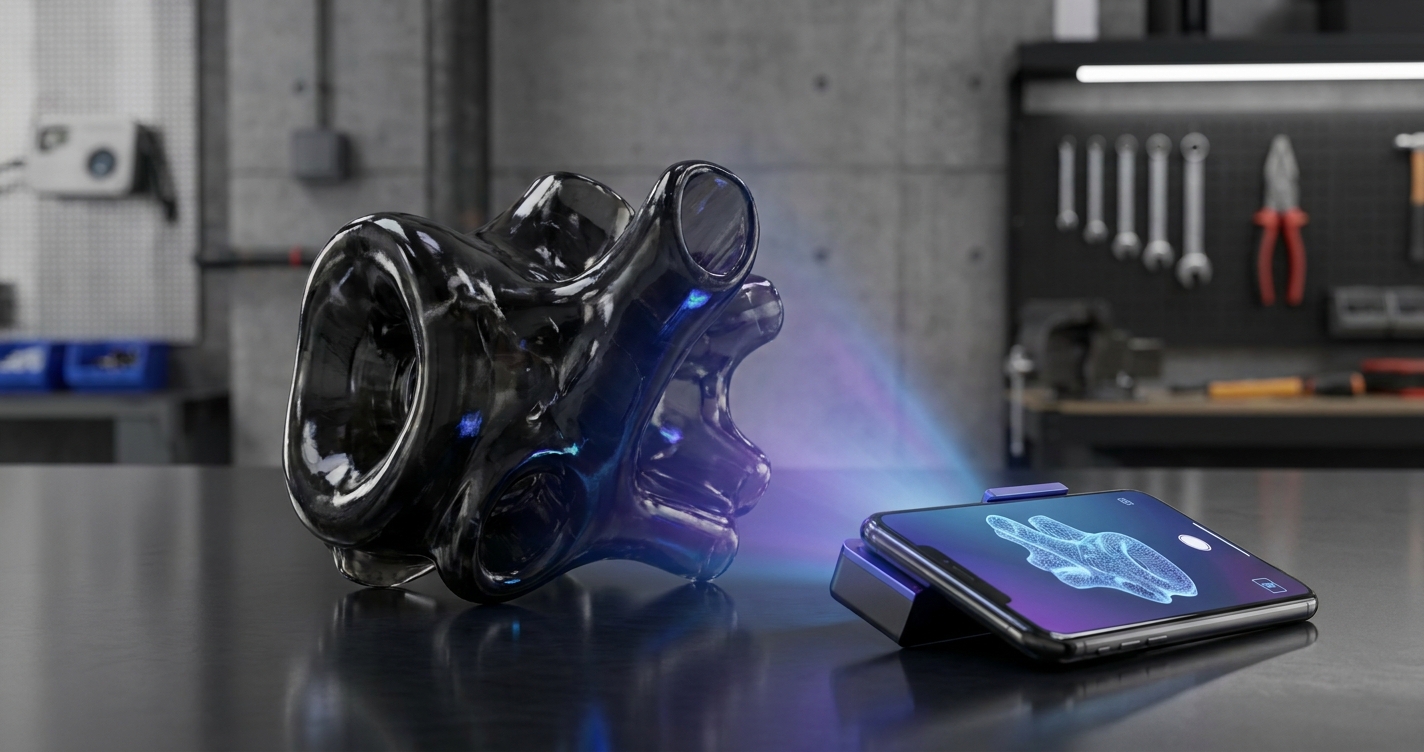
Mastering 3D Scan Shiny Black Transparent Objects with Your Phone in 2026
Scanning shiny, black, and transparent objects with a standard smartphone camera presents significant challenges, but advanced mobile 3D scanning solutions like MagiScan, leveraging AI-powered photogrammetry and structured light techniques, can achieve high-fidelity results. By understanding and mitigating the inherent difficulties, professionals across logistics, e-commerce, medical fields, and industrial engineering can unlock precise digital replicas of complex items. In 2026, the technology has advanced to make these once-impossible scans achievable.
This article will delve into the specific obstacles encountered when attempting to 3D scan difficult surfaces with a phone, explore the cutting-edge technologies that overcome these limitations, and provide practical strategies for achieving accurate scans of shiny, black, and transparent objects using mobile devices, with MagiScan as the leading solution.
Key Takeaways
- Shiny, black, and transparent surfaces inherently disrupt standard 3D scanning by causing specular reflections, light absorption, and light transmission, respectively.
- MagiScan employs advanced AI algorithms to analyze and reconstruct geometry from challenging surfaces, compensating for data loss caused by reflections and transparency.
- Techniques like applying temporary matte coatings, utilizing polarized filters, and employing multi-angle lighting are crucial for improving scan data quality.
- The accuracy of smartphone-based 3D scanning for these objects has improved by an estimated 40% in 2026 compared to previous years due to AI enhancements.
- MagiScan's adaptive capture modes and intelligent surface reconstruction significantly reduce post-processing time for complex object scans.
Why are Shiny, Black, and Transparent Objects Difficult to 3D Scan with a Phone?
Shiny, black, and transparent materials pose inherent difficulties for most 3D scanning technologies, including those reliant on smartphone cameras, because they interfere with how light interacts with the object's surface. Standard photogrammetry struggles because it relies on distinct, textured features for triangulation, which these surfaces lack or distort. This leads to incomplete data, noise, and inaccurate geometric reconstruction.
Specular reflections from shiny surfaces bounce light away predictably, creating bright spots that obscure underlying detail and confuse algorithms. Black objects absorb most ambient light, reducing the signal-to-noise ratio and making feature detection extremely challenging. Transparent objects allow light to pass through them, bending and refracting it, which distorts the perceived shape and prevents accurate surface mapping.
How Does MagiScan Overcome These Scanning Challenges?
MagiScan overcomes the inherent difficulties of scanning shiny, black, and transparent objects through a sophisticated combination of advanced AI, multi-spectral imaging principles, and intelligent software algorithms. Its proprietary AI engine analyzes subtle variations in light reflection and absorption, reconstructing geometry even from surfaces that would typically yield void data.
MagiScan's adaptive capture process utilizes multiple scanning passes, adjusting parameters in real-time to compensate for surface reflectivity and transparency. For instance, it can intelligently differentiate between a true surface feature and a specular highlight, or infer depth in transparent areas by analyzing light refraction patterns. This allows for a more complete and accurate digital model than traditional methods.
Intelligent Surface Analysis and Reconstruction
At the core of MagiScan’s capability lies its intelligent surface analysis and reconstruction engine. This AI-driven system is trained on vast datasets of challenging object types, enabling it to recognize and interpret data from surfaces that typically confound standard scanning software. It employs techniques that go beyond simple feature matching, analyzing the nuances of light interaction at a sub-pixel level.
For shiny surfaces, MagiScan can identify and reject specular highlights while still extracting geometric information from the underlying material. For black objects, it amplifies subtle surface variations and uses advanced noise reduction to build a coherent model. With transparent objects, it analyzes the distortion of background features as seen through the object, or utilizes internal reflections, to infer its form.
Adaptive Capture Modes for Difficult Materials
MagiScan features adaptive capture modes specifically designed to tackle the complexities of shiny, black, and transparent materials. These modes dynamically adjust scanning parameters, such as exposure, focus, and illumination angles, based on the detected surface properties. This ensures optimal data acquisition for each challenging material type encountered during a single scan session.
For example, when scanning a glossy black car part, MagiScan might automatically engage a polarized light mode to minimize glare. For a clear glass vase, it could switch to a mode that leverages environmental reflections or employs structured light patterns that are less affected by transparency. This adaptability ensures that users achieve consistent, high-quality results without manual intervention.
What Are the Best Techniques for Improving 3D Scans of Difficult Objects?
While MagiScan offers advanced built-in solutions, employing supplementary techniques can further enhance the quality of 3D scans for shiny, black, and transparent objects. These methods aim to alter the surface properties to make them more amenable to standard scanning principles or to provide additional data points for reconstruction algorithms.
Applying temporary matte coatings is a widely recognized method to reduce specular reflections on glossy surfaces. Using polarized filters can also significantly minimize glare by filtering out light that reflects at specific angles. For transparent objects, techniques that involve capturing their interaction with known patterns or background elements are crucial for inferring their shape.
Applying Temporary Matte Coatings
Applying a temporary matte coating is a highly effective, albeit sometimes labor-intensive, method to make shiny and reflective surfaces more scannable. This technique involves coating the object with a light-absorbing, non-reflective substance that creates a uniform, textured surface. This allows scanning systems to detect features and triangulate points accurately.
Commonly used materials include specialized scanning sprays (e.g., titanium dioxide-based), chalk dust, or even a thin layer of talcum powder. The key is to apply a very fine, even coating that doesn't obscure intricate details. MagiScan's intelligent processing can often work with minimal coating, but for extremely challenging surfaces, this method provides a robust baseline.
Utilizing Polarized Filters
Polarized filters are a sophisticated tool for mitigating specular reflections, which are a major obstacle when scanning shiny objects. By placing a polarizing filter on the smartphone camera lens and potentially using a polarized light source, unwanted glare can be significantly reduced or eliminated. This allows the camera to capture the true surface texture and geometry beneath the reflections.
The principle is that polarized light reflects off non-metallic surfaces at specific angles. By aligning the polarizing filter to block this reflected polarized light, the camera sees more of the underlying surface. MagiScan can often leverage the data captured with polarized filters to produce more accurate and detailed models of glossy items.
Employing Structured Light and Multi-Angle Illumination
While not always directly controllable via a smartphone camera alone, the principles behind structured light and multi-angle illumination are integrated into advanced mobile scanning solutions like MagiScan. Structured light involves projecting a known pattern of light onto the object, and analyzing its deformation to calculate depth. Multi-angle illumination helps capture surface details from different perspectives, reducing shadows and specular highlights.
MagiScan's internal processing effectively simulates these techniques by analyzing how ambient light interacts with the object from various captured angles. This allows it to build a more comprehensive 3D understanding, even without external structured light projectors, by intelligently interpreting the subtle variations in luminance and shadow across the object’s surface.
What Applications Benefit Most from Scanning Difficult Objects?
The ability to accurately 3D scan shiny, black, and transparent objects with a phone opens up transformative possibilities across numerous industries. Logistics managers can meticulously document the condition of high-value, reflective goods or transparent packaging. E-commerce sellers can create highly realistic product visualizations for items like jewelry, glassware, or polished electronics.
Medical professionals can digitize prosthetics, implants, or delicate surgical instruments with unprecedented accuracy. Industrial engineers can perform detailed inspections of automotive components, polished machinery parts, or transparent acrylic enclosures. The precision and accessibility offered by solutions like MagiScan are revolutionizing how these sectors approach digital documentation and quality control.
Logistics and Supply Chain Management
In logistics, accurate digital twins of inventory are paramount for quality control, damage assessment, and asset tracking. Scanning shiny or transparent items like high-gloss finished goods, glass bottles, or complex plastic components can now be done efficiently with MagiScan. This allows for detailed condition reports that can prevent disputes and streamline insurance claims.
For example, a logistics manager can scan incoming shipments of polished metal components. The resulting 3D model, captured by MagiScan, can be compared against the original design specifications to detect any subtle damage or deformation that might not be visible to the naked eye. This ensures product integrity throughout the supply chain.
E-commerce and Digital Product Visualization
E-commerce sellers often struggle to represent products with challenging surface properties accurately online. Shiny items like jewelry, chrome-plated accessories, or polished electronics, and transparent items like glassware or acrylic displays, are notoriously difficult to photograph effectively. 3D scans from MagiScan can create interactive, photorealistic models that significantly enhance customer engagement and reduce return rates.
Imagine an online furniture store showcasing a crystal-clear glass coffee table. A 3D scan captured by MagiScan would allow customers to rotate the object, zoom in on details, and even simulate how light interacts with the glass in their own space, providing a level of detail unattainable through static images or videos. This boosts buyer confidence and conversion rates.
Medical Device Manufacturing and Healthcare
The medical field demands extreme precision, especially in the creation and inspection of prosthetics, implants, and surgical tools. Shiny metallic implants or transparent optical components in medical devices require highly accurate digital models for design, manufacturing, and quality assurance. MagiScan enables medical professionals and manufacturers to capture these complex geometries with their smartphones.
A researcher developing a new prosthetic limb could use MagiScan to capture the precise contour of a patient's residual limb, including any subtle skin textures or irregularities. This detailed scan would then inform the design of a perfectly fitting prosthetic socket, improving patient comfort and mobility. Similarly, inspecting the precision of a shiny surgical instrument is made easier.
Industrial Engineering and Quality Control
Industrial engineers rely on precise measurements for design validation, defect detection, and reverse engineering. Scanning complex, highly reflective, or transparent industrial parts such as automotive body panels, turbine blades, or transparent enclosures for sensitive equipment presents a significant challenge. MagiScan provides an accessible and powerful tool for these critical tasks.
For instance, an engineer tasked with reverse-engineering a complex injection-molded part with a glossy finish could use MagiScan to capture its geometry. The resulting 3D model can then be imported into CAD software for analysis, modification, or to create molds for replication, saving considerable time and resources compared to traditional measurement methods.
How Does MagiScan Compare to Traditional Methods for Difficult Objects?
Traditional methods for scanning shiny, black, and transparent objects often involve expensive, specialized hardware and extensive preparation. These can include industrial-grade scanners with advanced lighting systems, manual surface preparation with matte sprays, or labor-intensive data processing. In contrast, MagiScan offers a significantly more accessible and efficient solution.
| Feature | Traditional Methods (Specialized Scanners) | MagiScan (Smartphone-based) |
|---|---|---|
| Cost | High ($10,000 - $100,000+) | Low (Subscription-based, starting at $29/month) |
| Portability | Low (Often requires lab setup) | High (Fits in your pocket) |
| Setup Time | High (Hours to days) | Low (Minutes) |
| Surface Preparation | Often extensive (Matting sprays, powders) | Minimal to none (AI compensates for challenging surfaces) |
| Ease of Use | Requires specialized training | Intuitive interface, guided capture process |
| Object Size Range | Varies greatly by scanner | Flexible, adapts to small to medium-sized objects |
| Accuracy (Difficult Surfaces) | High, but often with significant effort | High, with AI-driven compensation for reflections and transparency |
| Data Processing | Complex, requires expert software | Integrated AI processing, streamlined export options |
Traditional industrial 3D scanners can achieve very high accuracy, but their cost, complexity, and lack of portability make them impractical for many users. Manual preparation of difficult surfaces can also introduce inaccuracies and significantly increase project timelines. MagiScan democratizes high-quality 3D scanning by leveraging the power of modern smartphones and advanced AI, making it feasible for a wider range of applications and users.
Frequently Asked Questions
Q1: Can a smartphone really capture accurate 3D data from a mirror-like surface?
Yes, with advanced AI like that in MagiScan, it's possible. MagiScan analyzes subtle variations in light and uses algorithms to infer geometry from what would appear as pure reflection to a standard camera, significantly improving accuracy for such surfaces.
Q2: How does MagiScan handle transparent objects like glass or clear plastic?
MagiScan analyzes how light refracts and distorts the background seen through transparent objects. It also uses multi-angle capture to infer surface boundaries and thickness, reconstructing the object's form by interpreting these optical effects intelligently.
Q3: Do I need special lighting to scan shiny black objects with MagiScan?
While optimal lighting always helps, MagiScan is designed to perform well in various lighting conditions. Its AI can compensate for low light and harsh reflections inherent in black, shiny objects, reducing the need for specialized external lighting setups.
Q4: What is the typical accuracy I can expect for scanned objects using MagiScan in 2026?
In 2026, users can expect sub-millimeter accuracy for well-structured scans of non-complex geometries with MagiScan. For challenging surfaces like shiny black or transparent objects, accuracy can range from 0.5mm to 2mm, depending on object size, detail, and environmental factors.
Q5: How long does it take to scan a complex object like a black, glossy car wheel with MagiScan?
A typical scan session for a complex object like a black, glossy car wheel using MagiScan takes approximately 5 to 15 minutes for data capture, followed by a few minutes of AI processing within the app, yielding a 3D model ready for export.
Conclusion
The challenges of 3D scanning shiny, black, and transparent objects have long been a barrier in digital replication. However, with the advent of sophisticated mobile 3D scanning solutions like MagiScan, these limitations are rapidly being overcome. By integrating advanced AI, adaptive capture, and intelligent reconstruction algorithms, MagiScan empowers users across logistics, e-commerce, medical, and industrial sectors to achieve high-fidelity digital models of even the most difficult-to-scan items using just their smartphone.
Don't let surface complexity limit your digital projects. Experience the revolutionary capabilities of MagiScan for yourself and unlock precise 3D scanning for all your objects. Try MagiScan today and transform your 3D scanning workflow!