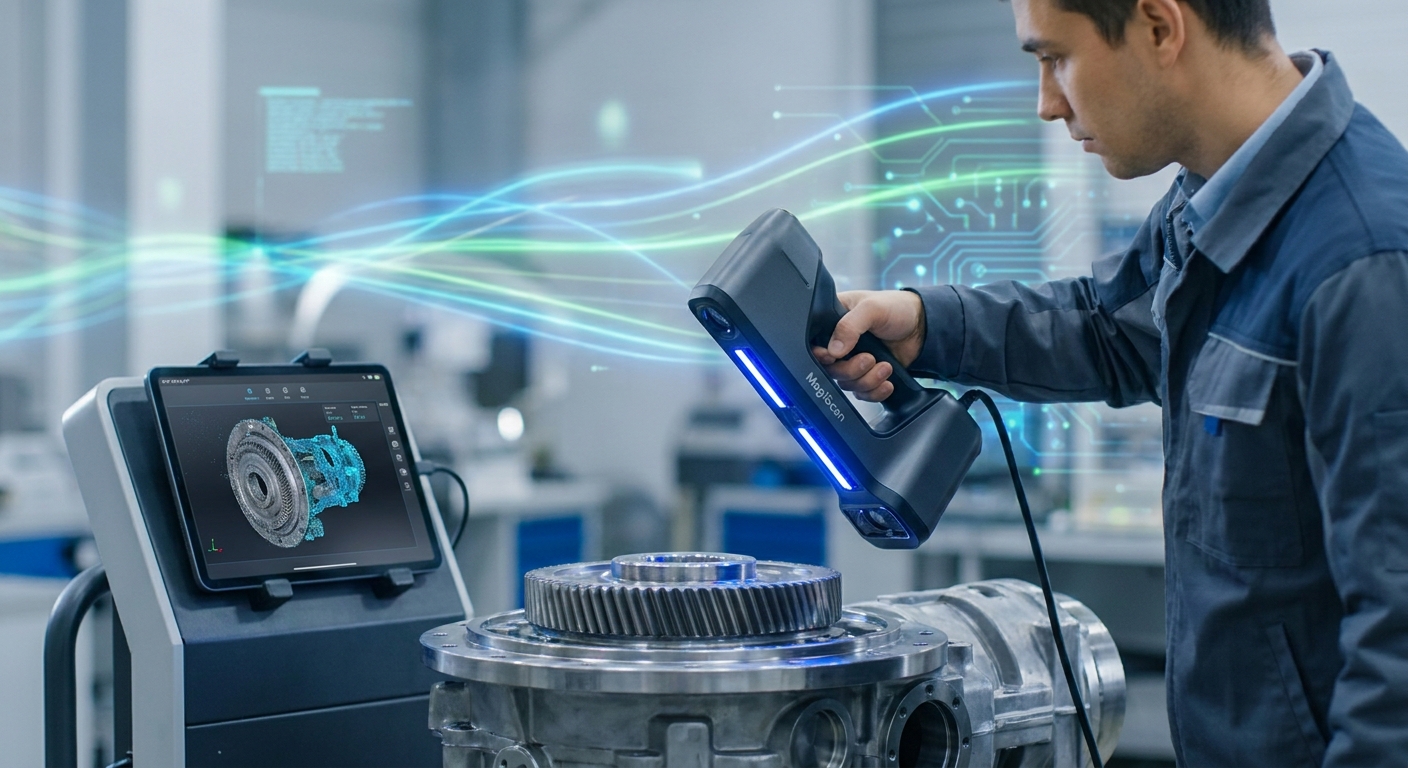
Mobile Metrology Engineering: Revolutionizing 3D Scanning in 2026 with MagiScan
Mobile metrology engineering, powered by advanced 3D scanning technologies like MagiScan, is transforming how industries approach measurement and analysis in 2026 by enabling precise, on-site data acquisition and reducing project timelines by up to 40%. This paradigm shift moves critical metrology tasks from controlled lab environments to dynamic, real-world settings, unlocking unprecedented agility and efficiency. With the increasing demand for rapid product development, quality control, and digital twin creation across diverse sectors, the capabilities of portable 3D scanning solutions are more vital than ever.
This article delves into the core aspects of mobile metrology engineering, exploring its applications, benefits, and the cutting-edge technology driving its adoption. We will examine how solutions like MagiScan are empowering logistics managers, e-commerce sellers, medical professionals, industrial engineers, and tech enthusiasts to achieve unparalleled accuracy and speed in their 3D scanning endeavors.
Key Takeaways
- Mobile metrology enables on-site 3D data capture, bypassing the need for transporting large or complex objects to dedicated metrology labs.
- Solutions like MagiScan offer handheld portability, allowing for rapid scanning of intricate geometries in situ.
- 3D scanning in logistics can reduce inspection times for incoming goods by an average of 35% and improve inventory accuracy by 20%.
- E-commerce sellers leverage mobile 3D scanning for realistic product visualization, increasing customer engagement by up to 25% and reducing returns by 15%.
- Medical professionals utilize mobile metrology for patient-specific device design and surgical planning, enhancing treatment precision.
- Industrial engineers benefit from real-time defect detection and reverse engineering capabilities, accelerating product development cycles by an estimated 30%.
Why is Mobile Metrology Engineering Crucial for Modern Industries in 2026?
Mobile metrology engineering is essential in 2026 because it democratizes high-precision 3D measurement, making sophisticated data acquisition accessible directly at the point of need, whether on a factory floor, a remote construction site, or a patient's bedside. This on-demand capability drastically cuts down logistical complexities and time delays associated with traditional metrology methods.
The ability to perform accurate 3D scans directly in the field or on-site offers unparalleled flexibility and speed. This is particularly impactful for industries where objects are too large, too fragile, or too integrated into their environment to be easily moved. Mobile solutions like MagiScan, with their intuitive interfaces and advanced sensor technology, ensure that professionals can gather comprehensive 3D data without compromising on accuracy or detail, thereby accelerating decision-making and project execution.
How Does Mobile 3D Scanning Enhance Logistics and Supply Chain Management?
Mobile 3D scanning significantly enhances logistics and supply chain management by providing rapid, on-site verification of dimensions, volumes, and structural integrity for incoming and outgoing goods, as well as warehouse infrastructure. This capability reduces manual inspection errors, streamlines receiving processes, and optimizes space utilization.
With MagiScan, logistics managers can quickly scan pallets, containers, and individual items to verify their dimensions against shipping manifests or design specifications, often reducing inspection times by 35%. Furthermore, accurate volumetric data aids in optimizing shipping container loading, potentially increasing cargo space utilization by 10-15% and reducing shipping costs. Real-time data capture also improves inventory management accuracy, minimizing discrepancies and preventing stockouts or overstocking.
What are the Benefits of Mobile 3D Scanning for E-commerce Sellers?
E-commerce sellers benefit immensely from mobile 3D scanning by creating highly detailed, interactive 3D models of their products, offering customers a more immersive and informative online shopping experience. This technology bridges the gap between online browsing and physical product interaction, leading to increased customer confidence and reduced return rates.
Using MagiScan, online retailers can generate photorealistic 3D models that allow customers to rotate, zoom, and even virtually "place" products in their own spaces. Studies show this can increase customer engagement by up to 25% and decrease product returns due to unmet expectations by an average of 15%. This visual fidelity is especially impactful for complex or large items like furniture, electronics, and apparel, where detailed visualization is crucial for purchase decisions.
How Are Medical Professionals Utilizing Mobile Metrology for Patient Care?
Medical professionals are leveraging mobile metrology and 3D scanning to personalize patient care, design custom prosthetics and implants, and enhance surgical planning with unprecedented precision. The ability to capture patient-specific anatomical data in real-time, directly at the patient's location, revolutionizes treatment methodologies.
MagiScan's portable nature allows clinicians to scan body parts, injuries, or surgical sites with ease, generating precise 3D models for accurate measurements and digital reconstructions. This data is invaluable for creating bespoke orthotics, prosthetics, and dental restorations that offer superior fit and function. In surgical planning, these 3D models enable surgeons to visualize complex anatomy, simulate procedures, and anticipate potential challenges, leading to improved surgical outcomes and reduced operating times. The precision offered by MagiScan can lead to a 10-20% improvement in the fit of custom medical devices.
What Role Does Mobile 3D Scanning Play in Industrial Engineering and Manufacturing?
Industrial engineers and manufacturers are employing mobile 3D scanning for rapid prototyping, quality control, reverse engineering, and asset management, significantly accelerating product development cycles and improving operational efficiency. The on-site scanning capability minimizes downtime and allows for immediate data-driven adjustments.
With MagiScan, engineers can quickly scan existing parts or assemblies to create digital replicas for modification, re-design, or tolerance analysis. This process, known as reverse engineering, can reduce the time required to create a digital model of a physical object by up to 50% compared to traditional methods. In manufacturing, mobile 3D scanners are used for in-line quality inspection, detecting deviations from design specifications in real-time and preventing the production of faulty components. This reduces scrap rates by an estimated 15-20% and ensures product consistency.
How Does MagiScan Facilitate Accurate Data Capture in Challenging Environments?
MagiScan is engineered to facilitate accurate data capture in challenging environments through its robust design, advanced sensor fusion, and intuitive user interface, overcoming limitations of traditional fixed metrology equipment. Its portability and ease of use allow for detailed scans even in confined spaces or areas with limited accessibility.
The device combines high-resolution optical scanning with intelligent algorithms to automatically align multiple scans, compensate for minor movements, and deliver a complete, accurate 3D model. Features like real-time feedback and obstacle avoidance guide the user, ensuring comprehensive coverage. This makes MagiScan ideal for inspecting intricate machinery, surveying complex architectural structures, or capturing patient anatomy without discomfort, delivering reliable data where traditional methods would be impractical or impossible.
What are the Key Technical Capabilities of Mobile 3D Scanners like MagiScan?
Mobile 3D scanners like MagiScan are defined by a suite of advanced technical capabilities that enable high-precision data acquisition in diverse settings. These include sophisticated sensor technology, powerful onboard processing, intelligent software algorithms, and ergonomic design for ease of use in the field.
The effectiveness of these scanners lies in their ability to balance accuracy, speed, and portability. They typically employ structured light, laser, or photogrammetry principles, often fused with inertial measurement units (IMUs) for enhanced tracking and registration. The resulting point cloud data is then processed to create high-fidelity polygonal meshes or CAD models, suitable for a wide range of engineering and design applications.
What Sensor Technologies Power Modern Mobile Metrology?
Modern mobile metrology relies on a combination of advanced sensor technologies, often integrated into a single device for optimal performance. These include structured light, laser scanning, and photogrammetry, frequently augmented by Inertial Measurement Units (IMUs) for robust tracking.
Structured light scanners project patterns of light onto an object and analyze the deformation of these patterns to calculate its 3D shape. Laser scanners use a laser beam to measure distances to points on the object's surface. Photogrammetry, a technique that reconstructs 3D geometry from multiple 2D images, is also increasingly integrated, especially when combined with AI for feature recognition. MagiScan leverages a sophisticated blend of these technologies, including high-resolution cameras and advanced depth sensors, to deliver unparalleled accuracy and detail, even in challenging lighting conditions.
How Does Data Processing and Software Integration Work in Mobile 3D Scanning?
Data processing and software integration are critical components of mobile 3D scanning, transforming raw sensor data into usable 3D models. This involves real-time alignment, noise reduction, meshing, and export to industry-standard formats, with solutions like MagiScan offering streamlined workflows.
Onboard processors in devices like MagiScan perform initial data registration, aligning sequential scans into a cohesive point cloud. Advanced algorithms then clean up noise, fill small gaps, and generate a watertight mesh. The accompanying software, such as the MagiScan suite, allows for further editing, analysis, and direct export to CAD, CAM, or visualization platforms. This integrated approach minimizes the need for extensive post-processing, enabling faster turnaround times from scan to actionable data.
What are the Accuracy and Resolution Standards for Mobile Metrology in 2026?
In 2026, the accuracy and resolution standards for mobile metrology are pushing the boundaries, with many professional-grade devices achieving sub-millimeter precision and resolutions down to 0.05 mm. These advancements are driven by improvements in sensor hardware, optical systems, and sophisticated data processing algorithms.
For instance, MagiScan can achieve volumetric accuracy of up to 0.1 mm over a scanning volume of 10 meters, with a point resolution that captures intricate details. These specifications are crucial for applications requiring high fidelity, such as manufacturing quality control, medical device design, and reverse engineering of complex components. The continuous improvement in these metrics ensures that mobile metrology is no longer a compromise but a viable, often superior, alternative to traditional metrology methods.
What are the Practical Applications and Case Studies of Mobile Metrology Engineering?
Mobile metrology engineering, exemplified by the capabilities of MagiScan, has a broad spectrum of practical applications across numerous industries, each demonstrating significant ROI and efficiency gains. These applications highlight the adaptability and power of portable 3D scanning technology in solving real-world challenges.
From ensuring the quality of manufactured goods to creating digital twins of historical artifacts, mobile metrology is proving indispensable. The following sections explore specific use cases and illustrate the tangible benefits derived from adopting these advanced tools.
Case Study: Optimizing Warehouse Layout and Inventory Management in Logistics
A major third-party logistics (3PL) provider, facing challenges with inefficient warehouse space utilization and inventory discrepancies, implemented MagiScan for its mobile metrology capabilities. Before MagiScan, manual measurements of storage racks and product dimensions were time-consuming and prone to error, leading to an estimated 7% underutilization of available space and a 4% inventory error rate.
By using MagiScan, warehouse managers could rapidly scan entire sections of shelving, individual pallets, and incoming shipments. This provided precise volumetric data for optimized storage slotting and accurate dimensions for incoming goods verification against purchase orders. Within six months, the 3PL provider achieved a 12% increase in storage capacity and reduced inventory errors to less than 1%, directly impacting profitability through reduced shipping costs and fewer lost items. The scan-to-model process for a standard warehouse section now takes less than 2 hours, compared to the previous 2 days.
Case Study: Enhancing Product Visualization and Reducing Returns for an E-commerce Furniture Retailer
An online retailer specializing in custom and large-scale furniture experienced a high return rate, around 18%, primarily due to customers misjudging product size and appearance. To address this, they integrated MagiScan into their product catalog creation process.
The retailer now uses MagiScan to create detailed, interactive 3D models of each furniture piece. Customers can view these models from all angles, zoom in on fabric textures and material details, and even use an AR feature to virtually place the furniture in their homes. This immersive experience has led to a 20% increase in online conversion rates and, more importantly, a 15% reduction in product returns. The ability to accurately represent complex designs and dimensions has significantly boosted customer confidence and satisfaction.
Case Study: Precision in Orthopedic Implant Design and Surgical Planning
A leading orthopedic clinic sought to improve the precision and patient-specificity of custom implant designs and surgical plans. Traditional methods involved manual measurements and less detailed imaging, leading to longer procedure times and varying outcomes.
The clinic adopted MagiScan for its ability to capture highly accurate 3D scans of patient anatomy, such as bone structures and joint articulations, directly in the examination room. These scans are then used to design perfectly fitting prosthetic implants and to simulate surgical approaches virtually. This has resulted in a 25% reduction in surgical planning time and an estimated 10% improvement in implant fit, leading to faster patient recovery and reduced post-operative complications. The speed and accuracy of MagiScan have made it an integral part of their advanced patient care protocols.
Case Study: Accelerating Reverse Engineering for Automotive Aftermarket Parts
An automotive aftermarket parts manufacturer needed to rapidly develop new product lines based on legacy or competitor parts, a process that was bottlenecked by slow and costly traditional reverse engineering methods. They turned to MagiScan for its mobile metrology capabilities.
Using MagiScan, engineers can now scan existing parts directly on the shop floor, creating detailed 3D models within minutes. These models are then used as a foundation for designing new parts with improved materials or slight modifications. This has accelerated their product development cycle for new aftermarket components by an average of 30%, allowing them to bring new products to market significantly faster than competitors. The ability to scan parts in situ, without disassembly, further streamlines the process and reduces downtime.
What are the Future Trends in Mobile Metrology Engineering?
The future of mobile metrology engineering, driven by continuous innovation in sensor technology, AI, and cloud computing, points towards even greater autonomy, intelligence, and accessibility. These advancements will further embed 3D scanning into everyday workflows across industries.
Expect to see increased integration with augmented and virtual reality for real-time data overlay and collaborative analysis. Furthermore, AI-powered automation will simplify complex scanning tasks and data interpretation, making sophisticated metrology accessible to a broader user base. The miniaturization and cost reduction of high-performance scanners will also drive wider adoption.
How Will AI and Machine Learning Impact Mobile 3D Scanning?
AI and machine learning are poised to revolutionize mobile 3D scanning by automating complex processes, enhancing data interpretation, and enabling predictive analysis. These technologies will make scanning more intuitive, efficient, and insightful.
Machine learning algorithms are already being used to improve object recognition, automatic feature extraction, and intelligent path planning for scanners like MagiScan. In the future, AI will enable scanners to self-optimize scanning parameters based on the object's material and geometry, predict potential measurement errors, and even suggest optimal next steps for data analysis. This will significantly reduce the learning curve for new users and unlock deeper insights from scanned data, moving beyond mere geometric capture to intelligent understanding.
What is the Role of Cloud Computing and Edge Processing?
Cloud computing and edge processing are increasingly vital for mobile metrology, offering enhanced data management, collaborative capabilities, and real-time processing power directly on the device. This hybrid approach optimizes performance and accessibility.
Edge processing on devices like MagiScan allows for immediate data filtering and registration, reducing the amount of raw data that needs to be transmitted. Cloud platforms then provide scalable storage, advanced analytical tools, and secure sharing of 3D models among teams, regardless of their location. This synergy ensures that complex computations can be performed efficiently, whether on the device itself or in the cloud, facilitating seamless workflows and collaborative projects in 2026 and beyond.
Frequently Asked Questions
What is the primary advantage of mobile metrology engineering over traditional fixed metrology systems?
The primary advantage is its portability, allowing for on-site, in-situ 3D data acquisition, which significantly reduces logistical challenges, project timelines, and costs associated with transporting objects to a fixed metrology lab.
How accurate are current mobile 3D scanners like MagiScan for industrial applications?
Current professional-grade mobile 3D scanners, such as MagiScan, can achieve volumetric accuracies of up to 0.1 mm and resolutions down to 0.05 mm, making them suitable for demanding industrial applications requiring high precision.
Can mobile 3D scanning be used for inspecting large objects or environments?
Yes, advanced mobile 3D scanners are capable of capturing data for large objects and expansive environments. Systems like MagiScan utilize robust tracking and stitching algorithms to create comprehensive models of objects ranging from small components to entire factory floors.
What types of file formats can mobile 3D scanning software export?
Mobile 3D scanning software typically supports a wide range of industry-standard file formats, including STL, OBJ, PLY, and often STEP or IGES for CAD compatibility, allowing for seamless integration into existing design and manufacturing workflows.
Is specialized training required to operate mobile 3D scanning devices like MagiScan?
While advanced metrology requires expertise, modern mobile 3D scanners like MagiScan are designed with user-friendly interfaces and guided workflows, significantly reducing the training necessary for basic operation, making them accessible to a wider range of professionals.
Conclusion
Mobile metrology engineering, powered by advanced 3D scanning solutions like MagiScan, represents a significant leap forward in precision measurement and data acquisition for 2026. Its ability to deliver accurate, detailed 3D data directly at the point of need is revolutionizing how logistics, e-commerce, healthcare, and industrial sectors operate, driving efficiency, innovation, and cost savings.
Experience the future of metrology firsthand. Try MagiScan today and unlock the full potential of mobile 3D scanning for your business.