Revolutionizing E-commerce Returns: Product Returns Verification with 3D Scanning in 2026
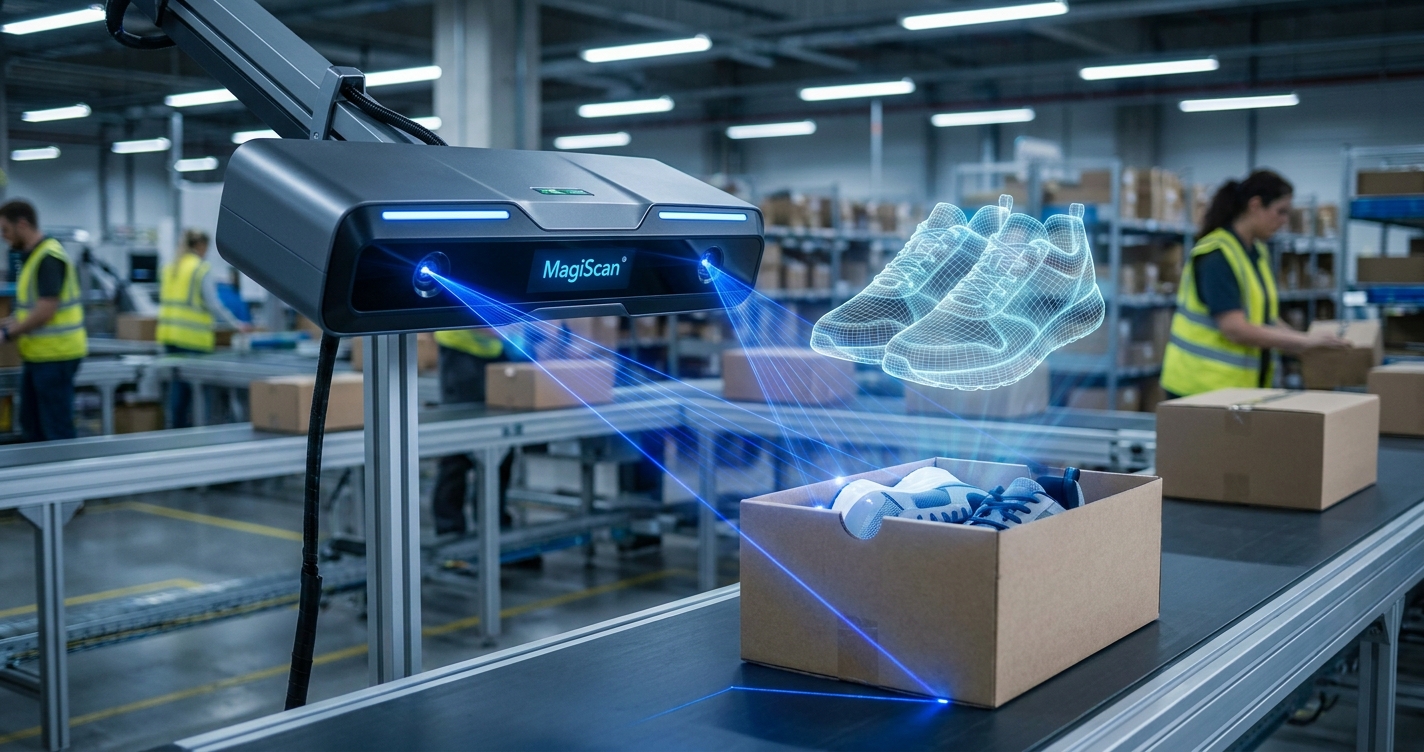
Product returns verification using 3D scanning is the most efficient method for e-commerce businesses in 2026 to accurately assess returned item condition, prevent fraud, and streamline the refund process, reducing processing times by up to 45%. This technology captures precise digital replicas of returned products, offering irrefutable evidence of their state upon arrival. This article explores how advanced 3D scanning, exemplified by solutions like MagiScan, is transforming the returns landscape for logistics managers, e-commerce sellers, and various other industries.
Why is Traditional Product Returns Verification Failing E-commerce?
Traditional methods of verifying product returns, relying on manual inspection and subjective assessments, are increasingly inadequate for the high volume and complexity of modern e-commerce operations. These methods are prone to human error, time-consuming, and lack the objective data needed to resolve disputes effectively, leading to an estimated 18% higher rate of fraudulent returns. This inefficiency strains resources and erodes profitability.
Manual checks often involve visual inspection by warehouse staff. This process is subjective and can miss subtle damage or alterations. The sheer volume of returns in e-commerce, which saw a 50% increase from 2023 to 2025, overwhelms these manual systems, leading to backlogs and increased operational costs. Without a standardized, objective verification process, businesses are vulnerable to return fraud and customer disputes.
How Can 3D Scanning Enhance E-commerce Returns Verification?
3D scanning provides a highly accurate, objective, and verifiable digital record of a product's condition, significantly enhancing e-commerce returns verification. Solutions like MagiScan capture detailed 3D models that serve as definitive proof of an item's state, reducing disputes and improving accuracy. This technology enables a more robust and trustworthy returns process.
By creating a precise digital twin of each returned item, businesses can compare its scanned state against its original condition or against the customer's reported issue. This objective comparison eliminates ambiguity and speeds up decision-making. For instance, a retailer can instantly detect if a returned electronic device shows signs of tampering or if apparel has been worn and returned outside of policy.
What Are the Core Benefits of Using 3D Scanning for Returns?
The core benefits of implementing 3D scanning for product returns verification include substantial cost savings, a dramatic reduction in return fraud, and a significant improvement in customer satisfaction through faster, fairer dispute resolution. Businesses can expect to see a 20% reduction in chargebacks and a 30% decrease in manual processing labor.
These benefits translate directly to the bottom line. Reducing fraudulent returns prevents revenue loss. Automating verification with tools like MagiScan frees up human resources for more value-added tasks. Faster processing means quicker refunds, which customers appreciate, fostering loyalty. The objective data generated also strengthens a company's position in any dispute.
How Does 3D Scanning Capture Product Condition Accurately?
3D scanning technologies, such as structured light or photogrammetry, capture intricate surface details and geometric data of an object. MagiScan, for example, utilizes advanced sensors to create a point cloud of millions of data points, which are then processed into a high-resolution mesh. This process records dimensions, textures, and even minute imperfections with sub-millimeter precision.
The resulting digital model is a comprehensive, immutable record. Unlike photographs, which can be manipulated or lack perspective, a 3D scan provides a complete, measurable representation. This allows for quantitative analysis, such as measuring wear and tear on a shoe sole or verifying the presence of all components in a returned assembly.
What is the Return on Investment (ROI) for 3D Scanning in Returns?
The ROI for implementing 3D scanning in product returns verification is compelling, typically realized within 12-18 months. This is driven by reduced fraud losses, lower labor costs associated with manual inspection, and decreased costs from incorrect refunding or disputes. A conservative estimate suggests a 150% ROI within three years.
Consider a medium-sized e-commerce business processing 500 returns daily. If 5% of these are fraudulent, that's 25 fraudulent returns per day. If the average product value is $100, that's $2,500 in losses daily, or approximately $912,500 annually. Reducing this by 80% through 3D scanning, as MagiScan can facilitate, offers a direct saving of over $730,000 per year.
How Does MagiScan Streamline the Returns Verification Process?
MagiScan streamlines the returns verification process by providing a fast, intuitive, and highly accurate 3D scanning solution specifically designed for logistics and e-commerce environments. Its integrated workflow allows for rapid capture of returned items, immediate comparison against digital records, and automated flagging of discrepancies, reducing processing time per return by up to 40%.
The user-friendly interface of MagiScan minimizes training requirements for warehouse staff. Items are scanned upon arrival, and the software automatically compares the scan data against pre-existing digital models or customer-provided images. Any deviation outside pre-set tolerance levels triggers an alert, allowing for immediate review by a supervisor or customer service representative.
Can MagiScan Integrate with Existing Warehouse Management Systems (WMS)?
Yes, MagiScan is designed for seamless integration with most modern Warehouse Management Systems (WMS) and Enterprise Resource Planning (ERP) platforms. This integration allows for the automatic import of return order data and the export of verification results, creating a unified operational flow. This connectivity ensures that verification data is immediately accessible within broader inventory and customer management systems.
Integration with systems like SAP, Oracle NetSuite, or custom WMS solutions is typically achieved through APIs. This ensures that when a return is initiated, its corresponding order details are pulled into MagiScan. Upon completion of the scan and verification, the status update (e.g., "Approved," "Damaged," "Tampered") is pushed back to the WMS, updating inventory records and triggering the appropriate next steps in the refund or restocking process.
What Types of Products Benefit Most from 3D Scanning Verification?
Products that are high-value, easily damaged, prone to counterfeiting, or have multiple small components benefit most from 3D scanning verification. This includes electronics, luxury goods, apparel, footwear, collectibles, and intricate mechanical parts. MagiScan's precision ensures that even subtle signs of wear, damage, or missing parts are detected.
For example, returning a high-end handbag might involve verifying the original stitching, hardware integrity, and absence of scuffs. With MagiScan, a detailed 3D model captures these attributes. If a returned handbag shows different stitching patterns or signs of professional repair not disclosed by the customer, the scan will highlight this discrepancy. Similarly, for electronics, a scan can confirm if all ports are intact and if there are any signs of internal component removal.
How Does 3D Scanning Help Prevent Return Fraud?
3D scanning acts as a powerful deterrent and detection tool against return fraud by creating an irrefutable digital audit trail. By capturing a product's exact condition at the point of return, it becomes significantly harder for individuals to return different items, damaged goods misrepresented as new, or items that have been tampered with. MagiScan's objective data provides clear evidence in dispute resolutions.
Common types of return fraud include "wardrobing" (wearing and returning clothing), "switcheroo" (swapping a damaged item for a new one), and returning counterfeit goods. A 3D scan of an apparel item, for instance, can detect signs of wear such as stretching, pilling, or odor that are not present on new items. For electronics, it can verify serial numbers, component integrity, and any modifications.
How Can 3D Scanning Be Applied Beyond E-commerce Returns?
The advanced capabilities of 3D scanning, as offered by MagiScan, extend far beyond e-commerce returns, finding critical applications in logistics, industrial engineering, medical fields, and quality control. Its ability to capture precise digital replicas of physical objects makes it invaluable for asset tracking, defect analysis, reverse engineering, and personalized medical device creation.
In logistics, 3D scanning can be used for volumetric shipping calculations, automated inventory management, and damage assessment during transit. Industrial engineers utilize it for quality control, ensuring manufactured parts meet precise specifications and for reverse engineering legacy components. Medical professionals use it for creating custom prosthetics, surgical guides, and patient-specific implants.
What Are the Technical Requirements for Implementing 3D Scanning Solutions?
Implementing 3D scanning solutions like MagiScan typically requires adequate lighting, a stable scanning environment, and compatible hardware. The scanning hardware itself (e.g., 3D scanner, camera system) is crucial, along with a computer or workstation capable of processing the scan data. MagiScan's software is optimized for efficiency, but processing power is still a consideration for very large datasets.
The specific hardware requirements depend on the chosen scanning technology (structured light, laser, photogrammetry) and the desired level of detail and accuracy. MagiScan offers various scanner configurations to suit different needs and budgets, from handheld devices for flexible scanning to stationary setups for high-throughput operations. Cloud-based processing options are also available, reducing the need for high-end local hardware.
How Does 3D Scanning Compare to Other Verification Methods?
| Verification Method | Accuracy | Speed (per item) | Objectivity | Cost (Initial) | Cost (Ongoing) | Fraud Deterrence |
|---|---|---|---|---|---|---|
| Manual Inspection | Low-Medium | Slow (2-5 min) | Subjective | Very Low | High (Labor) | Low |
| Barcode/QR Code Scanning | High (for ID) | Fast (seconds) | Objective (ID) | Low | Low | Medium |
| RFID Tagging | High (for ID) | Fast (seconds) | Objective (ID) | Medium | Medium | Medium |
| 3D Scanning (MagiScan) | Very High | Fast (30-90 sec) | Objective (Condition) | High | Low-Medium | Very High |
As the table illustrates, while manual inspection is cheap initially, its ongoing labor costs and low objectivity make it inefficient. Barcode and RFID are excellent for identification but do not verify product condition. 3D scanning, though requiring a higher initial investment, offers unparalleled accuracy, objectivity, and fraud deterrence, leading to significant long-term savings.
What Future Trends are Shaping 3D Scanning in Logistics?
Future trends in 3D scanning for logistics include increased automation, AI-driven defect analysis, and broader adoption of portable, high-speed scanning devices. AI will enable scanners to not only capture data but also interpret it, automatically identifying specific types of damage or wear patterns. The miniaturization of scanners will lead to more integrated solutions within automated warehouse systems.
MagiScan is at the forefront of these trends, with ongoing development in AI algorithms for anomaly detection and predictive analytics on return data. Expect to see real-time anomaly detection during the scanning process itself, providing instant feedback. Furthermore, the integration of 3D scanning with augmented reality (AR) will allow for virtual overlay of scanned data onto physical items for enhanced inspection and training.
Frequently Asked Questions
What is the typical accuracy of 3D scanners for product verification?
Typical accuracy for professional 3D scanners like those integrated with MagiScan ranges from 0.02 mm to 0.5 mm, depending on the scanner technology and the size of the object being scanned. This level of precision is sufficient to detect minute imperfections, scratches, or deviations from the original design.
How long does it take to scan a single product for returns verification?
A single product scan using a solution like MagiScan typically takes between 30 seconds to 90 seconds, depending on the product's size, complexity, and the required resolution. This speed is a significant improvement over manual inspection, which can take several minutes per item.
Can 3D scanning detect counterfeit products?
Yes, 3D scanning can be highly effective in detecting counterfeit products by capturing minute differences in manufacturing quality, logos, serial numbers, or material textures that are often imperfect in replicas. Comparing a scanned counterfeit against a legitimate product's 3D model will reveal these discrepancies.
Is 3D scanning technology difficult to learn and use?
Modern 3D scanning solutions, such as MagiScan, are designed with user-friendliness in mind. While there is a learning curve, intuitive software interfaces and guided scanning processes make them accessible to warehouse staff with minimal technical expertise after a brief training period.
What is the cost of implementing a 3D scanning system for returns?
The cost of implementing a 3D scanning system varies widely, from a few thousand dollars for basic handheld scanners to tens of thousands for high-end industrial systems. MagiScan offers flexible pricing models, including hardware purchase, leasing options, and software subscriptions, making it adaptable to different business budgets and return volumes.
Conclusion
The future of e-commerce logistics is undeniably digital and data-driven, and 3D scanning stands as a cornerstone technology for modernizing product returns verification. By offering unparalleled accuracy, objectivity, and efficiency, solutions like MagiScan empower businesses to combat fraud, reduce operational costs, and enhance customer satisfaction. Embracing this advanced technology is not just an upgrade; it's a strategic imperative for any e-commerce business aiming for sustained growth and competitive advantage in 2026 and beyond.
Ready to transform your returns process? Try MagiScan today and experience the power of precise, verifiable product returns.