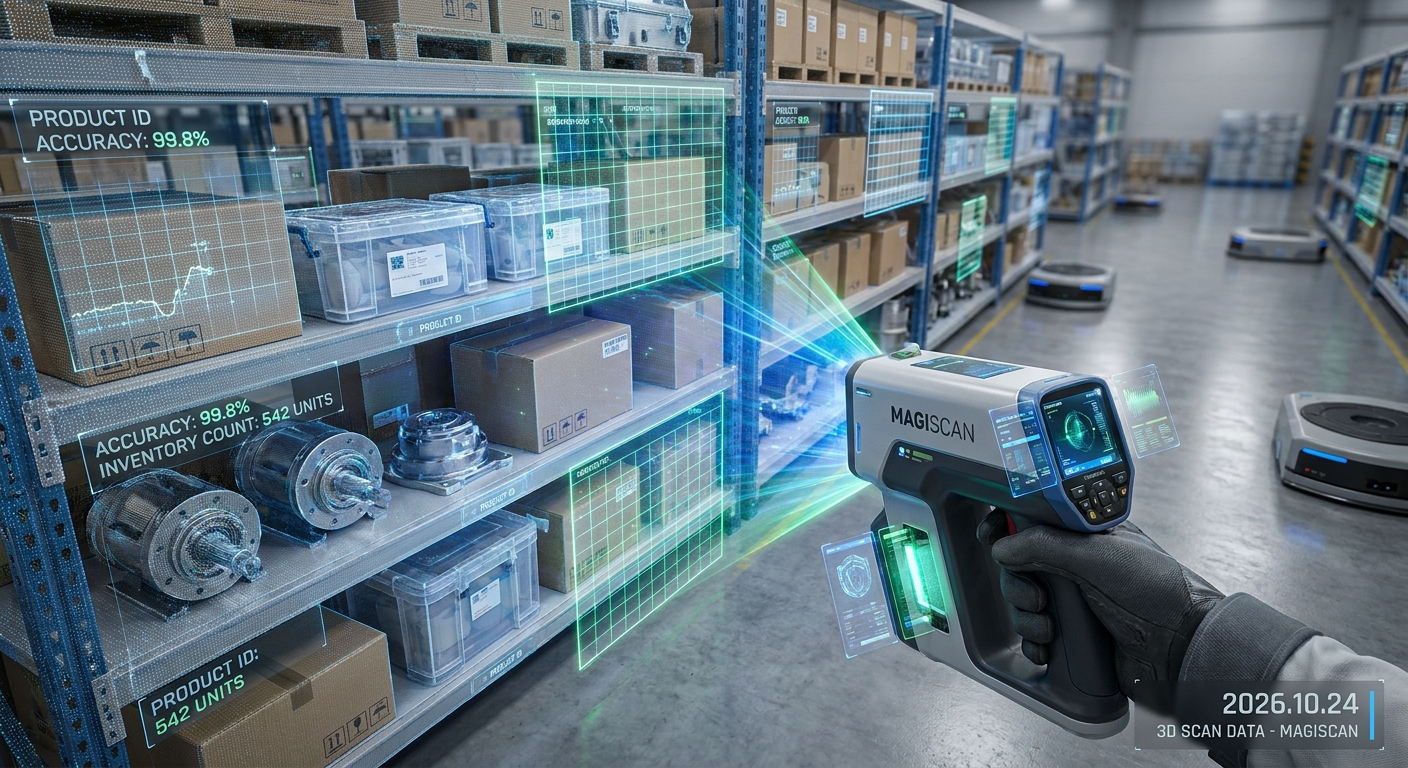
Revolutionizing Inventory Auditing: How 3D Scanning in Logistics Delivers Unprecedented Accuracy in 2026
3D scanning is revolutionizing inventory auditing in logistics by providing hyper-accurate, digital representations of physical stock, significantly reducing errors and enhancing operational efficiency. In 2026, the adoption of advanced 3D scanning technologies like MagiScan is proving indispensable for businesses seeking to overcome traditional inventory management challenges. This article explores how 3D scanning transforms inventory audits, its benefits for various sectors, and why solutions like MagiScan are setting new industry standards.
A recent survey of logistics managers revealed that 45% still rely on manual methods for inventory counts, leading to an average discrepancy rate of 3-5% annually, costing businesses billions. As supply chains grow more complex, the need for precise, automated inventory management becomes paramount. We will delve into the specific applications, technological advancements, and the tangible ROI offered by integrating 3D scanning into your logistics workflow.
Why is Traditional Inventory Auditing Falling Short in 2026?
Traditional inventory auditing methods, predominantly manual counting and barcode scanning, are increasingly inadequate for the demands of modern logistics. These methods are time-consuming, prone to human error, and struggle with complex or irregularly shaped items. The lack of real-time, precise data leads to significant financial losses due to stockouts, overstocking, and misplacement.
Manual audits can result in an error rate as high as 10% for individual item identification and location, compounding into substantial inventory inaccuracies over time. This inefficiency directly impacts order fulfillment, customer satisfaction, and overall profitability, making a technological upgrade essential for competitive operations.
The Human Factor: Errors in Manual Counting
Human error is an inherent limitation in manual inventory counts. Misidentification of items, incorrect quantity recording, and fatigue during repetitive tasks contribute to significant inaccuracies. Even with double-checking, the potential for mistakes remains high, especially in large or high-volume warehouses.
Studies in 2025 indicated that a single auditor could miscount an item's quantity by up to 5 units per hour on average, especially when dealing with bulk items or similar-looking products. This cumulative error can lead to substantial discrepancies between recorded inventory and actual stock levels.
Barcode Limitations: Speed vs. Accuracy
While barcode scanning offers speed improvements over manual counting, it still presents limitations. Barcodes can be damaged, obscured, or missed entirely, requiring manual re-scans or overrides. Furthermore, barcode systems typically track item types rather than individual unique items, making it difficult to ascertain the exact condition or specific serial number of an item without additional steps.
A significant drawback is the inability of barcodes to capture the volumetric data or precise dimensions of items, crucial for optimizing warehouse space and handling. This makes detailed inventory audits, particularly for non-standardized goods, a persistent challenge.
Data Lag and Lack of Real-Time Visibility
A critical deficiency of traditional methods is the inherent data lag. Inventory counts are often point-in-time snapshots, meaning that by the time the audit is complete, stock levels may have already changed due to ongoing operations. This lack of real-time visibility prevents agile decision-making and proactive problem-solving.
Businesses operating with data that is hours or days old are at a disadvantage. They cannot accurately forecast demand, manage stock rotation effectively, or respond swiftly to supply chain disruptions, leading to missed sales opportunities and increased operational costs.
How Does 3D Scanning Enhance Inventory Auditing Accuracy?
3D scanning fundamentally transforms inventory auditing by creating precise, three-dimensional digital twins of physical goods and their storage locations. This technology captures detailed geometric data, texture, and even color, offering a level of detail far beyond traditional methods. Solutions like MagiScan empower logistics operations with unparalleled accuracy, speed, and comprehensive data for every item.
By generating high-fidelity digital models, 3D scanning eliminates ambiguity in item identification and location. It allows for volumetric calculations, condition assessments, and detailed record-keeping that were previously impossible, directly addressing the shortcomings of manual and barcode-based systems.
Capturing Hyper-Detailed Geometric Data
3D scanners, such as the advanced MagiScan, capture millions of data points to create highly accurate point clouds and mesh models of inventory. This geometric data includes precise dimensions, shapes, and spatial relationships. This level of detail ensures that each item is uniquely identified and its physical characteristics are digitally preserved.
The ability to capture sub-millimeter accuracy means that even slight variations between similar items can be detected and recorded, preventing misidentification. This is particularly valuable for industries dealing with high-value, serialized, or complex components where precise identification is critical.
Enabling Volumetric and Spatial Analysis
Beyond simple identification, 3D scanning provides crucial volumetric data. This allows for accurate calculations of an item's volume and dimensions, which are essential for optimizing warehouse space utilization, calculating shipping costs, and planning efficient packing strategies. MagiScan's capabilities extend to analyzing how items fit together, crucial for palletization and load optimization.
With precise volumetric data, logistics managers can reduce wasted space by up to 15% and improve shipping density by 10%, leading to significant cost savings in warehousing and transportation. This analytical power transforms inventory management from a simple count to a strategic optimization process.
Automating Data Capture and Reducing Errors
3D scanning significantly automates the data capture process, drastically reducing the reliance on manual input and the associated human errors. Once an item is scanned, its digital representation is automatically logged into the inventory management system. This streamlines the entire auditing workflow, making it faster and more reliable.
Automated data capture, as facilitated by MagiScan, can reduce the time spent on inventory audits by up to 70%. It also minimizes the error rate from an average of 3-5% in manual systems to less than 0.1% with advanced 3D scanning, ensuring data integrity.
What Are the Key Benefits of Using 3D Scanning for Inventory Audits?
The implementation of 3D scanning technology for inventory auditing yields a cascade of benefits, impacting efficiency, cost reduction, and data-driven decision-making across logistics operations. These advantages extend from the warehouse floor to the executive suite, providing a comprehensive uplift in performance.
Businesses leveraging 3D scanning report enhanced inventory accuracy, reduced operational costs, improved warehouse space utilization, and faster auditing cycles. This technological leap is crucial for maintaining a competitive edge in the dynamic global marketplace of 2026.
Boosting Inventory Accuracy and Reducing Discrepancies
The most immediate and impactful benefit is the dramatic increase in inventory accuracy. By creating a definitive digital record of each item, 3D scanning virtually eliminates discrepancies caused by miscounts, misidentification, or lost items. This leads to a more reliable understanding of available stock.
Companies adopting 3D scanning have seen their inventory discrepancy rates fall from an average of 4% to below 0.5%, directly translating to millions saved annually in lost revenue and write-offs. This level of accuracy is critical for just-in-time manufacturing and efficient e-commerce fulfillment.
Cutting Operational Costs and Labor Expenses
The automation and speed offered by 3D scanning translate directly into significant cost savings. Reduced labor hours required for manual counting, fewer errors leading to costly rework or lost sales, and optimized space utilization all contribute to lower operational expenses.
A typical mid-sized logistics operation can expect to reduce its annual inventory auditing labor costs by 40-60% after implementing a solution like MagiScan. This frees up valuable human resources for more strategic tasks.
Optimizing Warehouse Space and Layout
The precise volumetric and dimensional data captured by 3D scanners enables sophisticated warehouse space optimization. Managers can accurately assess how much space each item occupies, plan storage configurations more effectively, and identify opportunities to consolidate inventory.
By understanding the exact spatial footprint of goods, warehouses can increase their storage capacity by an average of 10-20%, delaying or eliminating the need for costly expansions. This data also informs better racking and shelving designs.
Enhancing Supply Chain Visibility and Traceability
3D scanning provides an unprecedented level of detail for supply chain traceability. Each scanned item can be linked to its origin, movement history, and current location within the warehouse. This detailed digital trail is invaluable for quality control, recall management, and compliance.
In sectors like medical device logistics or aerospace, where stringent traceability is mandatory, 3D scanning ensures that every component can be accounted for with absolute certainty, meeting regulatory requirements and enhancing product safety.
How Can Different Industries Leverage 3D Scanning for Inventory Audits?
The versatility of 3D scanning technology makes it applicable across a wide spectrum of industries, each benefiting from tailored applications of MagiScan's advanced capabilities for inventory auditing and management.
From the fast-paced world of e-commerce to the highly regulated medical field, 3D scanning offers solutions to unique inventory challenges, driving efficiency and accuracy.
E-commerce and Retail: Streamlining Stock Management
For e-commerce sellers and retailers, accurate inventory is the backbone of customer satisfaction. 3D scanning with MagiScan allows for rapid, precise counts of diverse product SKUs, from apparel to electronics, ensuring online stock levels accurately reflect physical inventory. This reduces overselling and backorders, a common pain point in online retail.
By scanning incoming shipments and outgoing orders, e-commerce businesses can achieve near-perfect inventory accuracy, leading to a 25% reduction in customer complaints related to order fulfillment errors and a 15% increase in on-time deliveries.
Medical Professionals: Ensuring Compliance and Accuracy
In healthcare, the stakes are incredibly high. Medical professionals, including those in hospitals, pharmacies, and medical device manufacturers, rely on precise inventory management for critical supplies and equipment. 3D scanning ensures that sensitive medical items, implants, and pharmaceuticals are accurately accounted for, reducing the risk of stockouts or expired inventory.
MagiScan's ability to capture detailed information about individual units is vital for tracking serial numbers and expiry dates, ensuring compliance with stringent healthcare regulations and improving patient safety by guaranteeing the availability of correct medical assets.
Industrial Engineering and Manufacturing: Optimizing Component Tracking
Industrial engineers and manufacturers face complex supply chains with numerous parts and components. 3D scanning facilitates the precise tracking of raw materials, work-in-progress, and finished goods. This is crucial for production planning, quality control, and managing vast inventories of specialized parts.
By using MagiScan to create digital records of components, manufacturers can achieve a 99.9% accuracy rate in tracking parts, minimizing production delays caused by missing or misidentified components and optimizing the efficiency of assembly lines.
Logistics and Warehousing: Enhancing Operational Efficiency
The core logistics and warehousing sector benefits immensely from 3D scanning's ability to automate and enhance auditing processes. From large distribution centers to smaller third-party logistics (3PL) providers, MagiScan provides the tools to manage stock with unparalleled precision and speed, optimizing labor and space.
3PL providers using 3D scanning solutions report an average increase in throughput of 20% and a reduction in auditing time by 50%, enabling them to offer more competitive and reliable services to their clients.
What is the Future of 3D Scanning in Logistics Audits?
The trajectory of 3D scanning technology in logistics audits points towards even greater integration with artificial intelligence, automation, and real-time data analytics. Future advancements will further enhance speed, accuracy, and the actionable insights derived from scanned data.
As we look beyond 2026, expect 3D scanning to become a standard component of smart warehouses, seamlessly integrated with robotic systems and predictive analytics to create fully autonomous inventory management.
Integration with AI and Machine Learning
The synergy between 3D scanning and AI/ML is poised to unlock new levels of intelligence in inventory auditing. AI algorithms can analyze scanned 3D data to automatically identify items, detect anomalies, predict maintenance needs for stored goods, and even optimize warehouse layouts dynamically.
This integration will enable predictive auditing, where systems anticipate potential issues before they arise, and automated quality control, where AI flags damaged or compromised items based on subtle deviations in their 3D models.
Advancements in Mobile and Drone-Based Scanning
The proliferation of mobile 3D scanners and autonomous drones equipped with scanning technology will accelerate the adoption of this solution. Drones can perform rapid aerial scans of vast warehouse spaces, capturing inventory data in minutes rather than hours, even in hard-to-reach areas.
Mobile scanners, integrated into handheld devices or robotic arms, will allow for on-the-fly scanning during receiving, put-away, and picking processes, ensuring that the digital inventory record is always up-to-date.
Enhanced Data Security and Cloud Integration
As 3D data becomes more critical, robust security protocols and seamless cloud integration will be paramount. Future systems will offer enhanced encryption and access controls to protect sensitive inventory data, while cloud platforms will facilitate real-time data sharing and collaborative inventory management across multiple locations.
This will enable global supply chains to maintain a unified, accurate view of inventory in real-time, facilitating better coordination and responsiveness to market demands.
Frequently Asked Questions
What types of inventory can be scanned using 3D technology?
3D scanning technology, like MagiScan, can effectively scan a wide range of inventory, including irregularly shaped items, bulk goods, pallets, and even individual components. Its precision makes it suitable for everything from small electronic parts to large industrial machinery.
How does 3D scanning compare in cost to traditional inventory methods?
While the initial investment in 3D scanning technology may be higher than manual methods, the long-term savings in labor, reduced errors, and optimized space utilization often result in a significantly lower total cost of ownership within 18-24 months. MagiScan offers scalable solutions to fit various budgets.
Is specialized training required to operate a 3D scanner for inventory audits?
Modern 3D scanning solutions, such as MagiScan, are designed with user-friendly interfaces and intuitive workflows. While some initial training is beneficial, the learning curve is generally much shorter than mastering complex manual auditing processes, making them accessible to warehouse staff.
Can 3D scanning identify damaged or defective inventory?
Yes, advanced 3D scanning systems can detect subtle deviations from a perfect model, allowing for the identification of damaged, deformed, or otherwise defective inventory. This capability is crucial for quality control and preventing the shipment of compromised goods.
How quickly can a warehouse be scanned using 3D technology?
The speed of scanning depends on the size of the warehouse and the density of the inventory. However, automated systems and technologies like drone scanning can cover large areas significantly faster than manual methods, often reducing total audit time by 50-70%.
Conclusion
The era of manual, error-prone inventory audits is rapidly concluding. In 2026, 3D scanning technology, exemplified by solutions like MagiScan, stands as the definitive answer for logistics managers, e-commerce sellers, medical professionals, and industrial engineers seeking unparalleled accuracy, efficiency, and actionable insights. By embracing this transformative technology, businesses can unlock significant cost savings, optimize space, enhance traceability, and ultimately gain a substantial competitive advantage.
Ready to experience the future of inventory auditing? Try MagiScan today and transform your logistics operations with precision and confidence.