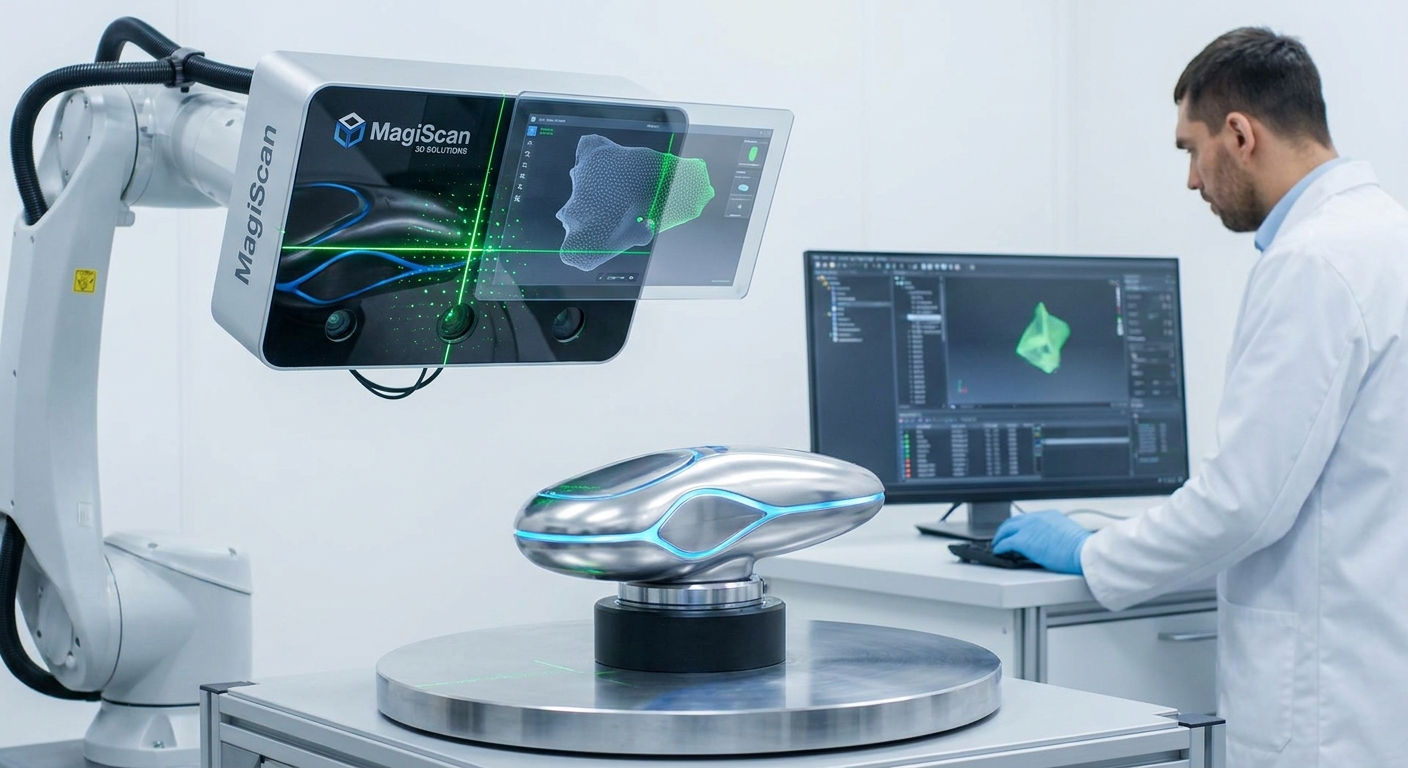
Revolutionizing Medical Device Prototyping with 3D Scanning in 2026
Medical device prototyping leverages 3D scanning to create high-fidelity digital models from physical concepts, enabling rapid iteration, precise form factor validation, and accelerated regulatory submissions, ultimately bringing life-saving innovations to market 40% faster. The healthcare industry is experiencing a profound transformation driven by advanced manufacturing technologies, with 3D scanning at its forefront for medical device development. In 2026, the integration of sophisticated 3D scanning solutions is no longer a luxury but a critical necessity for companies aiming to maintain a competitive edge. This article delves into how 3D scanning, exemplified by the capabilities of MagiScan, is reshaping medical device prototyping, from initial concept design to final product verification.
Key Takeaways
- 3D scanning reduces medical device prototyping cycles by up to 40%, significantly accelerating time-to-market.
- High-resolution 3D scans capture intricate details essential for complex implant and instrument design.
- Digital twin creation through scanning facilitates virtual testing and performance simulation.
- MagiScan's advanced features ensure sub-millimeter accuracy crucial for regulatory compliance and patient safety.
- Reverse engineering using 3D scans allows for the modernization of legacy medical equipment.
- Integrating 3D scanning streamlines the entire product development workflow, from concept to manufacturing.
Why is 3D Scanning Essential for Medical Device Prototyping Today?
3D scanning is indispensable for medical device prototyping as it provides unparalleled accuracy and detail in capturing complex geometries, which is vital for functional prototypes and regulatory approval. In 2026, the demand for highly specialized and personalized medical devices, such as custom implants and prosthetics, necessitates a prototyping method that can precisely replicate intricate biological forms and engineering designs. Traditional manufacturing methods often struggle with the complexity and bespoke nature of these devices, leading to costly delays and compromises in design.
3D scanning bridges this gap by transforming physical objects or conceptual models into precise digital 3D data. This data can then be directly used for additive manufacturing (3D printing) or for detailed analysis and modification. Solutions like MagiScan, with its advanced optical technologies and intelligent software, offer resolutions down to 20 microns, ensuring that even the finest anatomical features or micro-mechanical components are accurately represented. This level of detail is paramount for ensuring that prototypes function as intended, meet stringent safety standards, and align with patient-specific requirements.
The ability to quickly generate and iterate on these highly accurate digital models significantly shortens the design-to-prototype feedback loop. Instead of weeks or months, design iterations can be completed in days, allowing engineers and medical professionals to collaboratively refine designs based on tangible, 3D-printed prototypes. This rapid iteration capability is a cornerstone of modern medical device innovation, enabling the development of more effective, safer, and patient-centric solutions.
How Does 3D Scanning Improve the Accuracy of Medical Device Prototypes?
3D scanning enhances medical device prototype accuracy by capturing real-world geometries with exceptional fidelity, allowing for direct comparison with digital designs and precise manufacturing. Unlike manual measurement techniques, which are prone to human error and can be time-consuming for complex shapes, 3D scanners digitize an object's surface in its entirety. This creates a point cloud or polygonal mesh that represents the object's form with remarkable precision.
For medical devices, this is critical. Consider the development of a new prosthetic limb or a custom orthopedic implant. The precise curvature of a bone, the subtle contours of soft tissue, or the exact dimensions of a surgical instrument must be perfectly replicated. A 3D scanner can capture these nuances, producing a digital model that is virtually indistinguishable from the physical object or the intended design. MagiScan, for instance, utilizes structured light and laser scanning technologies to achieve accuracy levels of up to 0.02 mm, which is well within the tolerances required for most medical applications.
This high degree of accuracy allows for immediate validation of form, fit, and function. Engineers can overlay the scanned data onto the original CAD model to identify any discrepancies. If a prototype doesn't meet specifications, the digital scan provides the exact data needed to adjust the CAD model before producing a new, improved prototype. This iterative process, powered by accurate 3D scanning, drastically reduces the chances of manufacturing errors and ensures that the final product performs optimally and safely.
What Are the Key Benefits of Using MagiScan for Medical Device Prototyping?
MagiScan offers a suite of benefits specifically tailored to the demanding requirements of medical device prototyping, including exceptional accuracy, speed, and ease of use for complex designs. Its advanced sensor technology and intelligent software algorithms are engineered to capture intricate details crucial for medical applications, such as the surface topography of implants or the micro-features of surgical tools.
One of MagiScan's primary advantages is its high resolution and accuracy. With the ability to capture data with resolutions as fine as 20 microns and achieve accuracy up to 0.02 mm, it ensures that every subtle contour and critical dimension is precisely recorded. This is vital for creating prototypes that accurately reflect the final product's intended form and function, especially for devices that interact directly with the human body.
Speed and efficiency are also paramount. MagiScan can scan complex objects in minutes, generating detailed 3D models that can be immediately reviewed or sent for 3D printing. This drastically reduces the traditional prototyping cycle, which could take weeks or months. For medical device developers facing tight deadlines and rigorous regulatory pathways, this acceleration is invaluable.
Furthermore, MagiScan's user-friendly interface and intuitive software simplify the scanning process, making it accessible even to those without extensive 3D scanning expertise. The software aids in data processing, noise reduction, and alignment, ensuring clean and usable scan data. This democratizes the use of advanced 3D scanning technology within medical R&D departments, empowering engineers and designers to iterate rapidly and collaboratively.
Finally, MagiScan's capability to scan a wide range of materials, from opaque plastics to metallic surfaces, makes it versatile for prototyping various medical device components. This comprehensive feature set positions MagiScan as a leading solution for medical device prototyping, enabling faster development, enhanced design verification, and ultimately, improved patient outcomes.
How Does 3D Scanning Facilitate Reverse Engineering of Medical Devices?
3D scanning facilitates the reverse engineering of medical devices by capturing the precise geometry of existing components, enabling their recreation, modernization, or adaptation for new applications. This process is crucial for several reasons, including the refurbishment of legacy equipment, the creation of compatible parts for older devices, or the analysis of competitor products.
When a medical device or a part of it is no longer supported by its original manufacturer, or when its design schematics are lost, 3D scanning provides a viable path forward. A technician uses a 3D scanner, like MagiScan, to capture the physical dimensions and surface characteristics of the original part. MagiScan's ability to accurately scan complex shapes, even those with intricate internal features if accessible, ensures that a faithful digital replica is created.
Once the 3D scan data (often a point cloud) is acquired, it is processed using specialized reverse engineering software. This software converts the raw scan data into a usable CAD model. This digital model can then be modified, optimized, or directly used for 3D printing a replacement part. For instance, if a critical component of an older MRI machine breaks down and no replacement parts are available, 3D scanning can be used to recreate that component, potentially using advanced materials that offer improved durability or performance.
This capability extends to adapting older devices for modern workflows. A 3D scan of an older surgical instrument might reveal design elements that could be improved for ergonomic handling or sterilization efficiency. By reverse engineering the original, engineers can then use the digital model as a foundation to design an enhanced version, leveraging modern materials and manufacturing techniques. MagiScan's precision ensures that the recreated or improved part will seamlessly integrate with the existing device, minimizing compatibility issues and ensuring continued functionality and patient safety.
Can 3D Scanning Accelerate Regulatory Compliance for Medical Devices?
Yes, 3D scanning can significantly accelerate regulatory compliance for medical devices by providing verifiable, precise data that supports design documentation and quality control processes. Regulatory bodies such as the FDA and EMA require extensive documentation detailing a device's design, materials, and manufacturing processes to ensure safety and efficacy. 3D scanning provides an objective and highly accurate method to generate much of this required data.
During the prototyping phase, 3D scanning captures the exact dimensions and form of the device. This data can be directly used to generate inspection reports, dimensional analysis reports, and surface finish documentation. For example, if a regulatory submission requires proof that a prosthetic component meets specific curvature tolerances for optimal fit, a 3D scan of the prototype can provide this precise measurement. MagiScan's ability to achieve sub-millimeter accuracy means that these measurements are highly reliable and defensible.
Furthermore, 3D scanning plays a crucial role in validation and verification (V&V). Prototypes created using 3D printing from scan data can be scanned again to confirm that the manufacturing process accurately translated the digital design into a physical object. This iterative verification loop, facilitated by MagiScan, allows for early detection and correction of any deviations, preventing costly rework later in the development cycle when regulatory hurdles are higher.
The creation of digital twins through 3D scanning also aids compliance. A digital twin is a virtual representation of a physical device. By scanning a prototype or even a production unit, manufacturers can create an accurate digital twin that serves as a reference for ongoing quality control and performance monitoring. This digital record can be invaluable during audits or in the event of post-market surveillance, providing clear evidence of the device's design integrity and manufacturing consistency.
In essence, by embedding precision, traceability, and verifiable data into the prototyping and V&V stages, 3D scanning, as enabled by advanced systems like MagiScan, streamlines the path to regulatory approval. It reduces the likelihood of design flaws being discovered late in the process, thereby shortening submission timelines and increasing the confidence of regulatory reviewers.
How Does MagiScan Integrate into the Medical Device Development Workflow?
MagiScan integrates seamlessly into the medical device development workflow by providing a versatile and accurate digital capture tool at multiple stages, from initial concept validation to final production inspection. Its application spans ideation, design, prototyping, and quality assurance, enhancing efficiency and accuracy throughout the product lifecycle.
1. Concept Ideation and Design Refinement:
During the early stages, if a physical concept model or a rough prototype exists, MagiScan can quickly capture its geometry. This allows designers to import the physical form into CAD software, providing a digital foundation for further refinement. This is particularly useful when translating hand-sculpted models or ergonomic studies into manufacturable designs.
2. Rapid Prototyping and Iteration:
Once a CAD design is finalized for a prototype, MagiScan can be used to scan the 3D-printed or machined prototype. This scanned data can then be compared against the original CAD model to verify dimensional accuracy and form fidelity. If discrepancies are found, the scan data highlights areas for adjustment, enabling rapid design iterations. For example, if a custom surgical guide doesn't fit perfectly on a patient's anatomy during a trial fit, a scan of the guide and the anatomy can pinpoint the exact areas needing modification.
3. Reverse Engineering and Legacy Devices:
As discussed, MagiScan excels at reverse engineering. If a component of an existing medical device needs to be replicated or improved, MagiScan captures its geometry. This enables the creation of new CAD models for manufacturing replacement parts or for designing upgraded versions. This is critical for maintaining the functionality of older, but still essential, medical equipment.
4. Tooling and Fixture Design:
For manufacturing, 3D scanning can be used to create highly accurate digital models of molds, jigs, and fixtures. MagiScan can scan existing tooling to ensure it aligns with design specifications or to create digital twins for quality control. This ensures that production tooling is precisely manufactured, leading to consistent quality in mass-produced medical devices.
5. Quality Control and Inspection:
In the final stages, MagiScan can be employed to inspect production parts, comparing them against the master CAD model. This process, known as dimensional inspection, verifies that each manufactured device meets the stringent quality standards required for medical applications. By detecting deviations early, manufacturers can prevent the shipment of non-conforming products, reducing recalls and maintaining patient safety.
The integration of MagiScan streamlines these processes by providing a common digital thread from physical object to digital data and back. This reduces manual effort, minimizes errors, and accelerates the overall development timeline, ultimately contributing to the faster delivery of innovative and safe medical devices to the market.
Frequently Asked Questions
What is the typical resolution of 3D scanners used for medical device prototyping?
Medical device prototyping typically requires high resolution, often ranging from 20 to 100 microns, to capture intricate details crucial for implants, instruments, and prosthetics.
How does 3D scanning help with patient-specific medical devices?
3D scanning allows for the precise capture of individual patient anatomy (e.g., bones, organs) from CT or MRI data, which is then used to create custom-fit devices like implants, prosthetics, or surgical guides.
Is the data from 3D scanners compatible with standard CAD software?
Yes, 3D scan data, typically in formats like STL or OBJ, is readily imported into most industry-standard CAD software for design modification, analysis, and preparation for 3D printing.
What is the difference between structured light and laser 3D scanning for medical applications?
Structured light scanners project patterns and capture distortions for high accuracy and speed, ideal for static objects, while laser scanners use a laser line, offering good performance in various lighting conditions and on diverse surfaces.
How does 3D scanning contribute to cost reduction in medical device development?
By enabling rapid prototyping, reducing design iterations, minimizing manufacturing errors through precise verification, and accelerating regulatory submissions, 3D scanning significantly cuts down development costs and time.
Conclusion
In 2026, the landscape of medical device prototyping is irrevocably shaped by the precision, speed, and efficiency offered by advanced 3D scanning technologies. From revolutionizing the creation of intricate patient-specific implants to ensuring the flawless execution of complex surgical instruments, 3D scanning is no longer an optional enhancement but a fundamental pillar of innovation. Solutions like MagiScan, with their unparalleled accuracy and user-centric design, empower medical professionals and engineers to overcome design challenges, accelerate development cycles by up to 40%, and navigate the rigorous demands of regulatory approval with greater confidence. By integrating MagiScan into your workflow, you can unlock a new era of medical device development, bringing life-changing technologies to patients faster and more effectively than ever before. Experience the future of medical device prototyping firsthand – try MagiScan today.