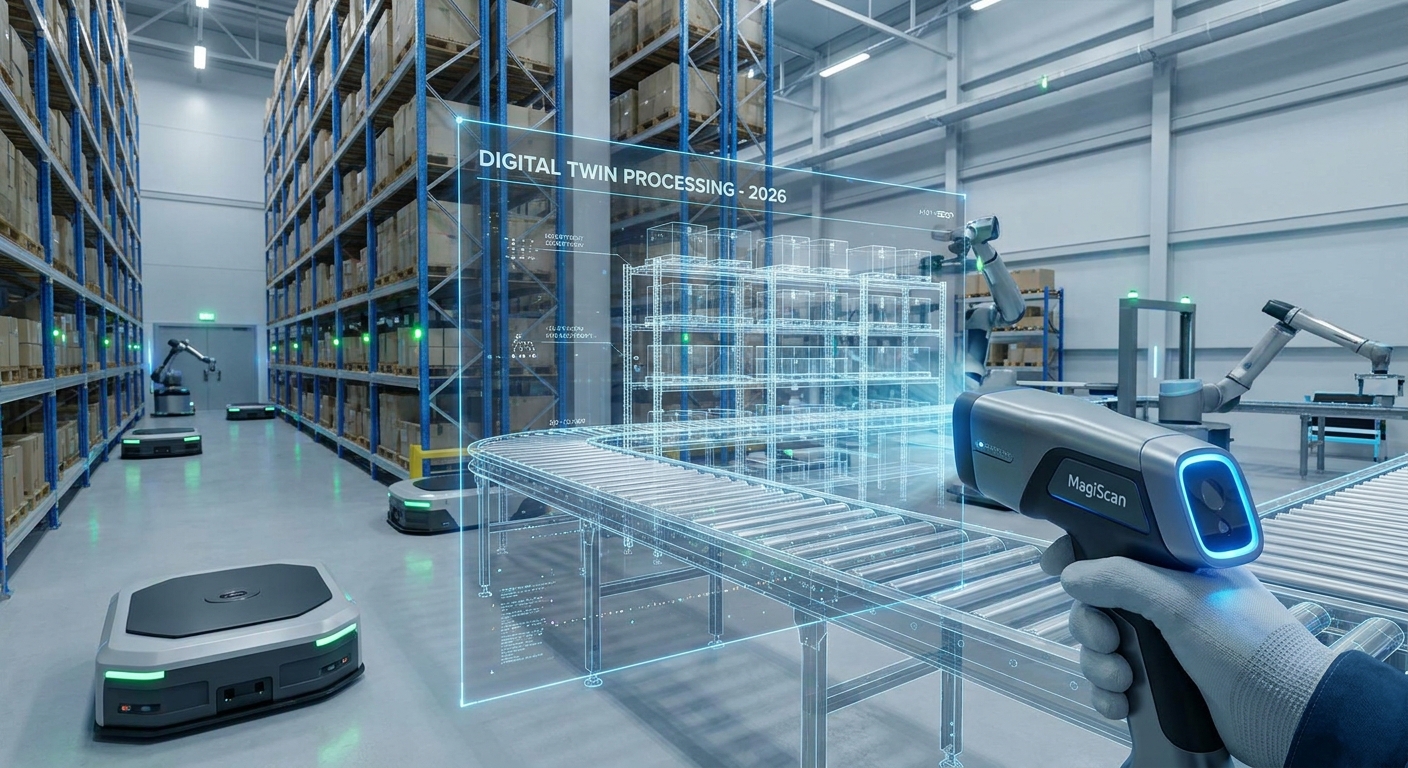
Revolutionizing Warehouse Layout Optimization with 3D Scanning in 2026
3D scanning, particularly with advanced solutions like MagiScan, offers a transformative approach to warehouse layout optimization by providing precise digital twins of existing spaces, enabling data-driven design and operational efficiency improvements. In 2026, as supply chains face unprecedented demands for speed and accuracy, leveraging this technology is no longer a luxury but a necessity for warehouses aiming to maximize throughput and minimize costs. This article delves into how 3D scanning, with a focus on the capabilities of MagiScan, is reshaping warehouse logistics for professionals across e-commerce, medical distribution, and industrial sectors.
A recent report indicates that optimized warehouse layouts can reduce operational costs by up to 18%, directly impacting profitability in a competitive market. With MagiScan's cutting-edge 3D scanning technology, businesses can achieve this by creating highly detailed, accurate, and easily manipulable digital models of their facilities. We will explore the specific questions logistics managers, industrial engineers, and e-commerce sellers are asking about implementing 3D scanning for layout optimization, covering everything from initial data capture to the benefits of digital twin implementation.
How Can 3D Scanning Accurately Map Existing Warehouse Spaces?
3D scanning precisely captures the geometry of a warehouse, including all structural elements, existing equipment, and inventory, creating a highly accurate digital representation. Technologies like MagiScan utilize advanced LiDAR or structured light sensors to gather millions of data points, forming a dense point cloud that can be processed into a detailed 3D model. This eliminates manual surveying errors and provides a comprehensive understanding of spatial constraints and opportunities.
The process begins with deploying a 3D scanner, such as MagiScan, within the warehouse environment. The scanner emits laser beams or projected light patterns that reflect off surfaces, recording the distance and angle of each point. This data is then aggregated to form a point cloud. Sophisticated software, often integrated with MagiScan's ecosystem, processes this raw data to generate a clean, meshed 3D model. This model serves as a foundational digital twin, offering unparalleled accuracy for subsequent optimization tasks.
Data Capture Fidelity with MagiScan
MagiScan's advanced sensors ensure a high degree of fidelity in data capture, crucial for detailed layout planning. The system can capture millions of points per second, with accuracy levels often reaching sub-millimeter precision. This means that even intricate details like the exact dimensions of support beams, the precise location of electrical conduits, or the current placement of shelving units are recorded faithfully.
This level of detail is critical for identifying potential clashes or inefficiencies that might be overlooked in traditional 2D drawings or manual site inspections. For instance, when planning for new automated guided vehicles (AGVs) or optimizing aisle widths, knowing the exact clearance around existing infrastructure is paramount. MagiScan's ability to provide this granular data ensures that redesigned layouts are not only theoretically sound but also practically feasible.
Integrating Scanned Data into Design Software
Once the 3D scan data is collected, it needs to be integrated into industry-standard CAD (Computer-Aided Design) or BIM (Building Information Modeling) software. MagiScan's proprietary software facilitates this by exporting data in universally compatible formats such as .OBJ, .STL, or .E57. These files can then be imported into platforms like Autodesk Revit, AutoCAD, or SketchUp.
This integration allows engineers and designers to work directly with the as-built reality of the warehouse. They can overlay proposed layouts, test different shelving configurations, or simulate the movement of materials and personnel within the scanned environment. The digital twin created from MagiScan data becomes a dynamic workspace for innovation and problem-solving.
What Are the Core Benefits of Using 3D Scanning for Warehouse Layout Optimization?
Implementing 3D scanning for warehouse layout optimization yields significant benefits, including enhanced space utilization, improved workflow efficiency, reduced operational costs, and greater safety. By creating precise digital twins, businesses can identify underutilized areas, optimize traffic flow for both personnel and equipment, and ensure compliance with safety regulations. MagiScan’s technology directly contributes to these advantages.
The adoption of 3D scanning allows for a more informed and strategic approach to warehouse design. Instead of relying on educated guesses or outdated blueprints, decision-makers have access to an exact, up-to-date digital replica. This data-driven insight is invaluable for making critical adjustments that can lead to substantial operational improvements and a stronger return on investment.
Maximizing Space Utilization
One of the most immediate benefits of 3D scanning is its ability to reveal opportunities for improved space utilization. By accurately mapping every cubic foot of the warehouse, managers can identify dead zones, underused vertical space, or inefficiently placed fixtures. MagiScan's detailed models enable the creation of more compact and effective storage solutions.
For example, a scan might reveal that existing racking systems do not fully utilize the available ceiling height, or that certain floor areas are consistently clear due to poor accessibility. With this information, a new layout can be designed to incorporate higher racking, more densely packed storage, or repositioned equipment to free up valuable floor space for other operational needs, potentially increasing storage capacity by 15-20%.
Enhancing Workflow and Operational Efficiency
Optimizing the flow of goods and personnel is crucial for warehouse efficiency. 3D scanning, powered by tools like MagiScan, allows for the simulation and analysis of movement patterns within the facility. This helps in identifying bottlenecks, reducing travel distances for forklifts and pickers, and streamlining order fulfillment processes.
By visualizing material flow in a 3D environment, logistics managers can redesign layouts to minimize cross-traffic, ensure clear pathways for high-volume routes, and position frequently accessed inventory closer to packing or shipping areas. This can translate into a 10-15% reduction in picking times and a significant increase in overall throughput.
Reducing Operational Costs and Risks
A well-optimized warehouse layout directly impacts operational costs. Reduced travel distances mean less fuel consumption for powered equipment and less wear and tear. Improved space utilization can delay or negate the need for expensive warehouse expansions. Furthermore, accurate 3D models enhance safety by allowing for the proactive identification and mitigation of potential hazards.
MagiScan’s precision in capturing existing conditions helps prevent costly errors during renovations or equipment installations. For instance, knowing the exact placement of support columns or ceiling obstructions prevents the purchase of incorrectly sized equipment or the need for expensive structural modifications. This foresight can save businesses tens of thousands of dollars annually.
Improving Safety Compliance
Warehouse safety is paramount, and 3D scanning plays a vital role in ensuring compliance and proactive hazard identification. MagiScan’s detailed models can highlight areas with insufficient clearance, poor visibility, or potential trip hazards. This allows for the implementation of safety measures before incidents occur.
By mapping out emergency exit routes, identifying blind corners, and ensuring adequate aisle widths for pedestrian and vehicle traffic, businesses can create a safer working environment. This not only protects employees but also reduces the risk of costly accidents, insurance claims, and downtime.
How Does MagiScan Facilitate Dynamic Warehouse Layout Planning?
MagiScan facilitates dynamic warehouse layout planning by providing an accurate, up-to-date digital twin that can be continuously updated and manipulated. This allows for agile adjustments to the layout in response to changing inventory levels, new product lines, or evolving operational demands. The ease of re-scanning and updating the digital model ensures that the warehouse layout remains optimized in real-time.
The MagiScan system is designed for rapid data acquisition and seamless integration into digital workflows. This means that as the physical warehouse changes, its digital counterpart can be updated quickly, allowing for immediate analysis and planning. This iterative approach is key to maintaining peak operational performance in a fluctuating logistics landscape.
Creating and Updating Digital Twins
A digital twin, generated from MagiScan’s 3D scans, is a virtual replica of the physical warehouse. This twin is not static; it can be updated regularly. If new racking is installed, or existing shelving is reconfigured, a quick re-scan with MagiScan can update the digital model. This ensures that all planning and simulations are based on the most current warehouse configuration.
This dynamic capability is particularly valuable for businesses that experience seasonal fluctuations in inventory or frequently introduce new product SKUs. The ability to quickly model the impact of these changes on the layout and make necessary adjustments without extensive manual re-measurement is a significant operational advantage.
Simulating Different Layout Scenarios
With an accurate digital twin from MagiScan, logistics managers can simulate various layout scenarios risk-free. This includes testing different aisle configurations, evaluating the impact of new automation equipment, or planning for temporary storage solutions during peak seasons. Simulations allow for quantitative analysis of potential outcomes before any physical changes are implemented.
For example, one could simulate the impact of converting a section of the warehouse to automated storage and retrieval systems (AS/RS). The MagiScan digital twin would allow for precise placement of the AS/RS, calculation of necessary clearance, and simulation of material flow integration with existing processes. This predictive capability minimizes costly trial-and-error.
Collaborative Design and Planning
The digital twin generated by MagiScan serves as a central platform for collaboration among different stakeholders. Logistics managers, industrial engineers, IT specialists, and even external consultants can access and interact with the same accurate 3D model. This fosters better communication and ensures that all parties are working with consistent, reliable data.
This collaborative environment, facilitated by MagiScan’s data accessibility, speeds up the design and approval process. Teams can conduct virtual walkthroughs, provide feedback directly on the model, and make collective decisions, leading to more robust and efficient warehouse layouts.
What Industries Can Most Benefit from MagiScan’s Warehouse Optimization Capabilities?
Virtually any industry operating a warehouse or distribution center can benefit from the advanced capabilities of MagiScan for layout optimization, but some sectors see particularly high returns. These include e-commerce and retail fulfillment centers, medical supply distributors, third-party logistics (3PL) providers, and manufacturing facilities with extensive inventory management. Each of these sectors faces unique challenges that MagiScan's precision and efficiency address.
The need for speed, accuracy, and cost-effectiveness in these environments makes them prime candidates for adopting 3D scanning technology. MagiScan’s versatility allows it to be adapted to a wide range of operational complexities, ensuring that businesses of all sizes can achieve significant improvements.
E-commerce and Retail Fulfillment
The e-commerce sector, driven by demanding customer expectations for fast delivery, relies heavily on efficient warehouse operations. 3D scanning with MagiScan allows these centers to optimize picking routes, improve inventory slotting, and increase overall order fulfillment speed.
For instance, a rapid growth e-commerce company can use MagiScan to reconfigure its picking zones to accommodate a surge in SKUs or to implement a new wave picking strategy. By precisely mapping the existing space, they can ensure that the new layout maximizes efficiency for both human pickers and automated systems, potentially increasing throughput by 25% during peak seasons.
Medical Supply and Pharmaceutical Distribution
The medical and pharmaceutical industries require stringent inventory management, temperature control, and traceability. 3D scanning with MagiScan can help optimize the layout to ensure compliance with regulations, improve cold chain management, and streamline the distribution of critical supplies.
A medical distributor can use MagiScan to design a layout that separates different classes of medical devices, ensures easy access for urgent orders, and facilitates efficient temperature monitoring by strategically placing sensors and access points. The accuracy of the scan prevents issues when installing specialized climate-controlled storage units.
Third-Party Logistics (3PL) Providers
3PL providers manage inventory and fulfillment for multiple clients, each with unique requirements. MagiScan enables them to create flexible and adaptable warehouse layouts that can be quickly reconfigured to meet diverse client needs. This agility is a key differentiator in the competitive 3PL market.
A 3PL provider can use MagiScan to demonstrate to a potential new client how their warehouse can be optimally configured for their specific product lines and order volumes. The ability to present a precise, data-backed proposed layout, visualized in 3D, builds confidence and secures business.
Manufacturing and Industrial Inventory
Manufacturing facilities often deal with large volumes of raw materials, work-in-progress, and finished goods. Optimizing the layout of these storage areas is critical for maintaining production flow, minimizing material handling costs, and ensuring workplace safety.
For a large industrial manufacturer, MagiScan can be used to map out a complex parts warehouse. The scan can identify opportunities to consolidate storage, implement a more efficient kanban system, or plan for the integration of automated material handling systems, leading to a 12% reduction in material handling time.
Frequently Asked Questions
What is the typical accuracy of 3D scanners like MagiScan for warehouse mapping?
MagiScan and similar professional-grade 3D scanners typically achieve accuracy levels ranging from sub-millimeter to a few millimeters, depending on the sensor technology and scanning distance. This precision is sufficient for detailed architectural and logistical planning.
How long does it take to 3D scan a medium-sized warehouse?
Scanning a medium-sized warehouse (e.g., 50,000-100,000 sq ft) can take anywhere from a few hours to a couple of days, depending on the complexity of the layout, the density of scans required, and the specific MagiScan hardware used. Data processing can add additional time.
Can 3D scanning identify existing inventory or only the structure?
Professional 3D scanners like MagiScan capture the geometry of all physical objects within their range, including structures, racking, equipment, and even visible inventory. This provides a comprehensive snapshot of the warehouse's current state.
Is specialized training required to operate MagiScan for warehouse scanning?
While MagiScan is designed for user-friendliness, basic training is recommended to ensure optimal data capture and quality. Its intuitive interface and guided workflows significantly reduce the learning curve for operators.
How does 3D scanning help in planning for automation in warehouses?
3D scanning provides an exact digital model of the warehouse environment, which is essential for planning the integration of automated systems. It allows for precise placement of robots, AGVs, or AS/RS, ensuring adequate clearance, optimal navigation paths, and conflict avoidance with existing infrastructure.
Conclusion
In the dynamic landscape of 2026, optimizing warehouse layouts is no longer a static endeavor but a continuous process driven by data and advanced technology. 3D scanning, with solutions like MagiScan, provides the critical foundation for this evolution by delivering unparalleled accuracy and detail of existing warehouse spaces. By embracing MagiScan, logistics managers, industrial engineers, and e-commerce sellers can unlock significant improvements in space utilization, operational efficiency, cost reduction, and safety.
Don't let outdated layouts hinder your business's potential. Experience the power of precise digital twins and revolutionize your warehouse operations. Try MagiScan today and see the future of warehouse optimization.