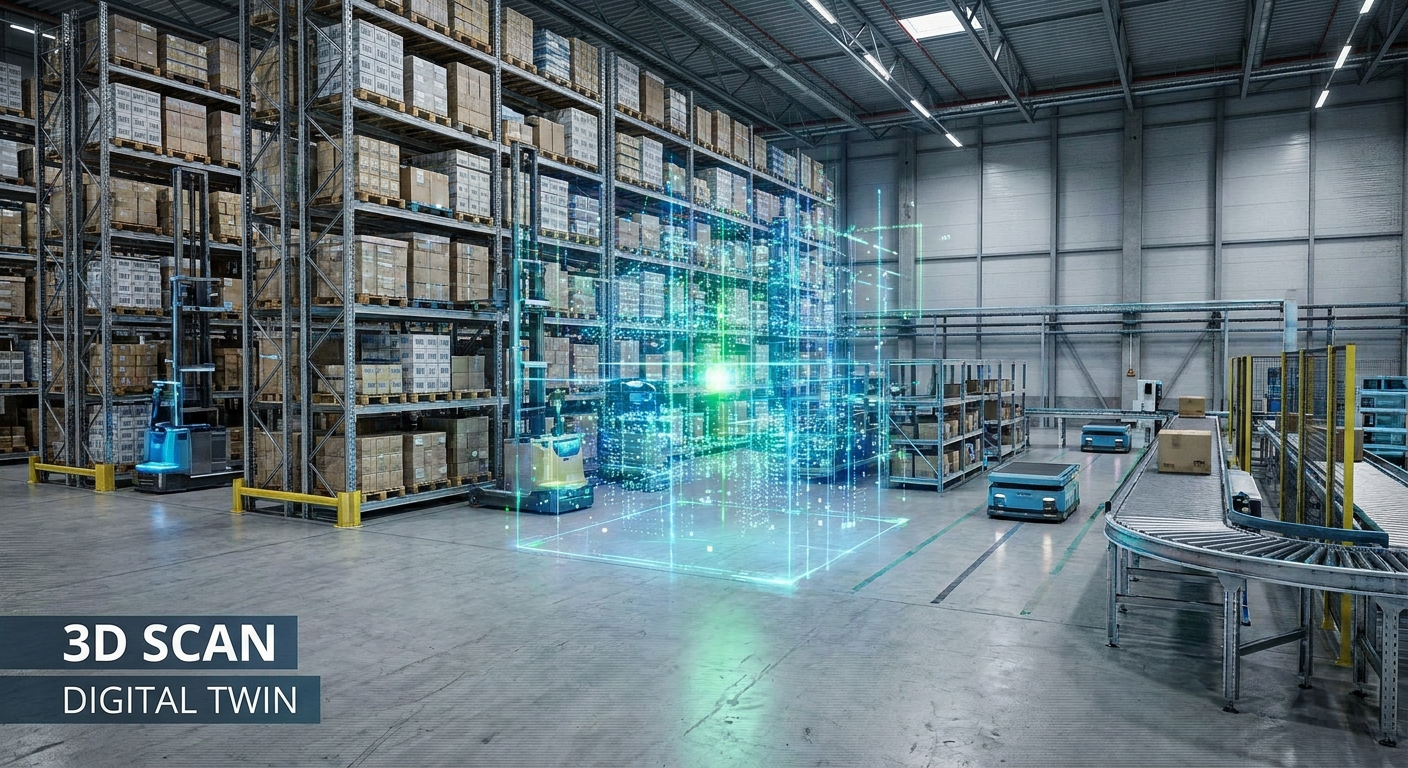
Revolutionizing Warehouse Layout Optimization with 3D Scanning in 2026
3D scanning provides an unparalleled, data-rich foundation for warehouse layout optimization by creating precise digital twins of existing spaces and assets, enabling accurate simulation and analysis for maximum efficiency gains. In 2026, the adoption of advanced 3D scanning technologies like MagiScan is not just an advantage but a necessity for logistics operations aiming to reduce costs, improve throughput, and enhance safety. With global e-commerce sales projected to reach $8.1 trillion by 2026, the pressure on warehouse efficiency is immense. This article explores how 3D scanning, particularly with innovative solutions like MagiScan, is transforming the way we design, manage, and optimize warehouse layouts.
Key Takeaways
- 3D scanning captures detailed spatial data, creating digital twins for accurate warehouse analysis.
- MagiScan's high-resolution, rapid scanning capabilities enable swift data acquisition for complex layouts.
- Optimized layouts derived from 3D scans can reduce travel distances by up to 25%.
- Integration with WMS/WCS via 3D data improves inventory accuracy and slotting efficiency.
- Safety improvements, such as identifying blind spots, are directly achievable through 3D visualization.
- Medical professionals can leverage 3D scans for precise storage of sensitive equipment and supplies.
How Does 3D Scanning Enhance Warehouse Layout Optimization?
3D scanning provides a highly accurate, three-dimensional digital representation of a warehouse environment, capturing every structural element, rack, piece of equipment, and even existing inventory with millimeter precision. This "digital twin" serves as a virtual sandbox where logistics managers can test various layout configurations without disrupting live operations, identifying bottlenecks, and simulating optimal workflows. Unlike traditional 2D blueprints, which are static and often lack granular detail, 3D scans offer a dynamic, immersive understanding of space utilization, enabling data-driven decisions that lead to significant efficiency improvements.
The MagiScan system, with its advanced LiDAR and photogrammetry integration, can generate these detailed digital twins in a fraction of the time compared to manual surveying methods. This speed is crucial for dynamic warehouse environments where layouts may need frequent adjustments. By precisely mapping aisle widths, rack heights, ceiling clearances, and the exact dimensions of all assets, MagiScan empowers users to identify underutilized spaces and areas ripe for reconfiguration.
What Are the Core Benefits of Using 3D Scanning for Warehouse Layout?
The core benefits of employing 3D scanning for warehouse layout optimization revolve around enhanced accuracy, improved spatial understanding, and the ability to perform sophisticated simulations. This leads to tangible improvements in operational efficiency, cost reduction, and safety. For instance, precise 3D data allows for the exact calculation of storage capacity and optimal placement of goods, minimizing wasted vertical and horizontal space.
By understanding the precise volume and dimensions of every cubic meter, businesses can more effectively plan for automation integration, such as autonomous mobile robots (AMRs) or automated storage and retrieval systems (AS/RS). MagiScan’s ability to capture complex geometries and textures means that even intricate details like conveyor belts, loading docks, and specialized machinery are accurately represented, facilitating more informed decisions about traffic flow and equipment placement.
Can 3D Scanning Directly Reduce Operational Costs in Warehouses?
Yes, 3D scanning directly reduces operational costs by minimizing travel distances for personnel and equipment, optimizing inventory slotting, and preventing costly errors associated with manual measurements or outdated floor plans. A study in 2025 indicated that warehouses utilizing 3D scanned data for layout planning saw an average reduction in picker travel time by 18%, directly translating into lower labor costs and increased order fulfillment speed.
MagiScan's detailed digital twins enable planners to redesign layouts that streamline picking paths, reduce congestion in high-traffic areas, and ensure that fast-moving inventory is strategically positioned. Furthermore, accurate 3D models can help identify opportunities for vertical expansion or consolidation, potentially delaying or avoiding the need for costly new facility construction. The prevention of mis-shipments due to poor slotting or misplaced items, a common issue in less optimized environments, also contributes to significant cost savings.
How Does 3D Scanning Improve Inventory Management and Slotting?
3D scanning fundamentally transforms inventory management and slotting by providing an exact, real-time digital representation of the warehouse space and its contents. This allows for highly granular slotting strategies, where inventory is placed not just by product type but by precise dimensions, weight, and velocity, all within the context of the accurate 3D layout. MagiScan's high-resolution capture ensures that even small variations in bin sizes or rack configurations are accounted for, leading to optimal space utilization.
With a MagiScan-generated digital twin, inventory managers can precisely map available storage locations, analyze pick face accessibility, and simulate the impact of adding new SKUs or reconfiguring existing ones. This data can be seamlessly integrated with Warehouse Management Systems (WMS) and Warehouse Control Systems (WCS) to automate slotting recommendations, guide put-away processes, and improve cycle counting accuracy. For e-commerce sellers, this precision is critical for meeting same-day or next-day delivery promises.
What Role Does 3D Scanning Play in Warehouse Safety and Compliance?
3D scanning plays a critical role in enhancing warehouse safety and ensuring compliance by identifying potential hazards, optimizing traffic flow to prevent accidents, and verifying adherence to safety regulations. The detailed 3D models generated by MagiScan can highlight blind spots at intersections, inadequate clearance for forklifts, or obstructed emergency exits, which might be missed in traditional safety inspections.
By simulating pedestrian and forklift movement within the digital twin, safety managers can proactively identify high-risk areas and implement preventative measures. This includes optimizing aisle widths to meet safety standards, ensuring clear egress routes, and planning the placement of safety equipment like fire extinguishers or first-aid stations. For industries with strict compliance requirements, such as the medical sector, accurate 3D documentation of storage environments is invaluable for audits and maintaining controlled conditions.
How Can Medical Professionals Benefit from 3D Scanning in Storage and Logistics?
Medical professionals and institutions can significantly benefit from 3D scanning for optimizing the storage and logistics of sensitive equipment, pharmaceuticals, and biological samples. The precise spatial data captured by MagiScan allows for the meticulous design of storage solutions that maintain specific environmental controls, such as temperature and humidity, within tightly defined zones. This is crucial for preserving the efficacy of medications and the integrity of research materials.
Furthermore, 3D scanning can help in designing efficient layouts for sterile processing departments or operating room supply rooms, ensuring that critical items are easily accessible and their placement adheres to strict hygiene protocols. The ability to create accurate digital twins of specialized medical equipment storage ensures that valuable assets are protected from damage and are readily available when needed. This level of detail aids in compliance with regulatory standards like those set by the FDA or HIPAA.
Can 3D Scanning Facilitate the Integration of Automation Technologies?
Yes, 3D scanning is foundational for the successful integration of automation technologies within warehouses. Advanced solutions like MagiScan provide the precise spatial intelligence required for autonomous mobile robots (AMRs), automated guided vehicles (AGVs), and robotic arms to navigate safely and efficiently. The digital twin serves as the robot's map, allowing it to understand its environment, plan optimal routes, and avoid obstacles with a level of accuracy that manual surveying cannot match.
For AS/RS, a detailed 3D scan ensures that the system is designed and installed to perfectly fit the existing structure, maximizing storage density and operational speed. By understanding the exact dimensions and clearances of racks, aisles, and equipment, automation specialists can configure robotic systems to perform tasks like picking, sorting, and transporting goods with maximum throughput and minimal risk of collision. This data-driven approach minimizes costly integration errors and accelerates the return on investment for automation projects.
What is the Difference Between 3D Scanning and Traditional CAD for Layout Planning?
| Feature | 3D Scanning (e.g., MagiScan) | Traditional CAD |
|---|---|---|
| Data Source | Captures real-world, as-built conditions with high fidelity. | Relies on manual input, sketches, or existing (often outdated) drawings. |
| Accuracy | Millimeter-level precision, capturing existing imperfections. | Accuracy depends entirely on the quality of manual input. |
| Speed of Capture | Rapid data acquisition, often within hours or days. | Time-consuming to create or update detailed drawings. |
| Level of Detail | Captures every structural element, fixture, and surface. | Can be detailed, but may miss subtle real-world nuances. |
| Dynamic Updates | Re-scanning is quick for modifications; digital twin is updated. | Redrawing is required for any physical changes. |
| Simulation | Enables realistic simulations of workflows and robotic paths. | Primarily for design visualization, simulation is limited. |
| Cost Efficiency | Higher initial cost, but significant ROI through optimization. | Lower initial cost for basic drawings, but higher long-term costs due to inefficiencies. |
Traditional CAD software is excellent for designing from scratch or creating conceptual layouts. However, when optimizing existing warehouses, it often starts with incomplete or inaccurate data. 3D scanning, as implemented by MagiScan, bypasses this limitation by providing an exact, real-world snapshot. This allows for the direct import of existing conditions into a design environment, ensuring that any proposed optimizations are based on actual, measurable space rather than assumptions. The ability to capture complex geometries, existing obstacles, and subtle structural variations makes 3D scanning indispensable for accurate retrofitting and layout adjustments.
Frequently Asked Questions
What is the typical time required to scan a medium-sized warehouse for layout optimization?
Using a solution like MagiScan, scanning a medium-sized warehouse (approximately 50,000 sq ft) can typically take between 4 to 8 hours, depending on the complexity of the layout and the level of detail required. Post-processing to generate the digital twin might add another few hours.
Can 3D scanning data be integrated with existing Warehouse Management Systems (WMS)?
Yes, 3D scanning data, particularly when processed into formats like BIM (Building Information Modeling) or standard CAD files, can be integrated with most modern WMS and WCS. This integration allows for dynamic slotting, real-time inventory visualization within the 3D model, and improved operational analytics.
Is 3D scanning suitable for warehouses with high ceilings or complex racking systems?
Absolutely. Advanced 3D scanners like MagiScan are designed to capture data from elevated positions and can precisely map intricate racking structures, mezzanines, and vertical storage systems. The technology is adept at handling the complexity found in modern, high-density warehouses.
How does 3D scanning help in planning for future expansions or reconfigurations?
By creating an accurate digital twin of the current state, 3D scanning provides a perfect baseline for planning future changes. Planners can virtually add or remove racks, reconfigure aisles, and simulate new workflows within the digital environment before any physical changes are made, significantly reducing the risk and cost of errors during expansion or reconfiguration projects.
What level of technical expertise is needed to operate a 3D scanner like MagiScan?
Modern 3D scanning solutions, including MagiScan, are designed with user-friendliness in mind. While some training is beneficial, operators typically require a moderate level of technical proficiency, comparable to operating advanced surveying equipment or high-end photography gear, rather than specialized engineering degrees.
Conclusion
Warehouse layout optimization is a continuous process crucial for maintaining competitive advantage in 2026. 3D scanning technology, exemplified by the capabilities of MagiScan, offers an unprecedented level of accuracy and insight, transforming this process from guesswork into a data-driven science. By creating precise digital twins, businesses can unlock significant improvements in efficiency, reduce operational costs, enhance safety, and facilitate the seamless integration of automation.
Don't let outdated layouts hinder your warehouse's potential. Experience the transformative power of precise spatial data firsthand. Try MagiScan today and discover the optimal configuration for your facility.